
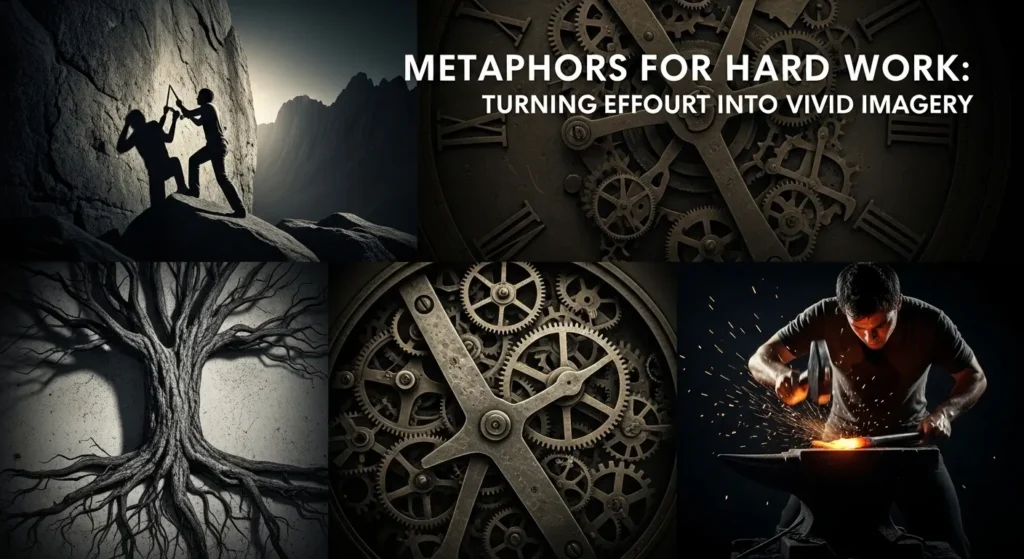
Hard work is often described in plain terms—effort, persistence, discipline—but these
abstract words rarely capture the emotional intensity behind sustained struggle.
Whether we are striving for personal growth, navigating professional challenges, or managing
social pressures, hard work often feels like a conflict: between comfort and ambition,
fear and courage, exhaustion and determination.
Metaphors help transform this invisible tension into something we can see and feel.
By comparing effort to climbing mountains, forging steel, or running marathons,
we make the experience of hard work tangible and relatable. Metaphors do more than decorate language—
they shape how we understand struggle, resilience, and progress.
Below is a carefully structured list of 22 powerful metaphors for hard work.
Each includes a clear meaning, a natural sentence example, alternative expressions, and insight
into its emotional or psychological significance.
1. Climbing a Mountain
Meaning: Working steadily toward a challenging goal that requires endurance and focus. Example: Building her startup felt like climbing a mountain—every step was exhausting
but brought her closer to the summit. Alternatives: Scaling new heights, uphill journey, steep climb. Insight: This metaphor emphasizes gradual progress and the satisfaction of reaching hard-earned milestones.
2. Burning the Midnight Oil
Meaning: Working late into the night to complete tasks. Example: He burned the midnight oil to finish the project before the deadline. Alternatives: Staying up late, working into the night. Insight: Highlights sacrifice and commitment, often tied to ambition or pressure.
3. Grinding It Out
Meaning: Persisting through repetitive or exhausting work. Example: She ground it out through months of training before the competition. Alternatives: Pushing through, toughing it out. Insight: Reflects mental toughness and endurance during long, unglamorous phases.
4. Carrying the Weight of the World
Meaning: Bearing heavy responsibility. Example: As team leader, he felt like he was carrying the weight of the world. Alternatives: Heavy burden, loaded shoulders. Insight: Captures emotional pressure and responsibility in professional and personal roles.
5. Planting Seeds
Meaning: Investing effort now for future results. Example: Her volunteer work was like planting seeds for a better community. Alternatives: Laying foundations, sowing effort. Insight: Encourages patience and faith in long-term rewards.
6. Hammering Away
Meaning: Working persistently at a task. Example: He kept hammering away at the proposal until it was perfect. Alternatives: Chipping away, working steadily. Insight: Suggests focused, repeated effort leading to gradual breakthroughs.
7. Running a Marathon
Meaning: Sustained effort over a long period. Example: Writing a novel is a marathon, not a sprint. Alternatives: Long haul, endurance race. Insight: Reminds us to pace ourselves and value consistency.
8. Weathering the Storm
Meaning: Enduring difficulties with resilience. Example: The company weathered the storm of economic uncertainty. Alternatives: Riding out the storm, surviving turbulence. Insight: Emphasizes emotional resilience and stability under pressure.
9. Forging Steel
Meaning: Becoming stronger through intense effort. Example: The hardships forged her character like steel in fire. Alternatives: Tempered by fire, hardened by experience. Insight: Frames struggle as transformative rather than destructive.
10. Building Brick by Brick
Meaning: Creating success step by step. Example: He built his career brick by brick. Alternatives: Piece by piece, layer by layer. Insight: Encourages structured, patient growth.
11. Breaking New Ground
Meaning: Doing innovative or difficult work. Example: The research team broke new ground in medical science. Alternatives: Pioneering work, trailblazing. Insight: Links hard work to courage and discovery.
12. Swimming Against the Current
Meaning: Working despite opposition. Example: She swam against the current of public opinion. Alternatives: Going against the tide, resisting the flow. Insight: Highlights courage and independence.
13. Climbing the Ladder
Meaning: Advancing in career or status. Example: He worked tirelessly to climb the corporate ladder. Alternatives: Moving up the ranks, rising through the levels. Insight: Suggests structured ambition and competitive effort.
14. Carrying the Torch
Meaning: Continuing responsibility or legacy through effort. Example: She carried the torch for her mentor’s vision. Alternatives: Upholding tradition, continuing the legacy. Insight: Connects hard work with purpose and continuity.
15. Plowing Through
Meaning: Moving forcefully through obstacles. Example: He plowed through hours of paperwork. Alternatives: Powering through, pushing ahead. Insight: Suggests determination in the face of resistance.
16. Walking a Tightrope
Meaning: Balancing effort and risk carefully. Example: Managing finances felt like walking a tightrope. Alternatives: Balancing act, delicate maneuver. Insight: Reflects mental strain and precision.
17. Digging Deep
Meaning: Finding inner strength during difficulty. Example: She dug deep to finish the final lap. Alternatives: Summoning strength, reaching within. Insight: Emphasizes inner resilience and emotional endurance.
18. Lighting a Fire
Meaning: Sparking motivation or intense effort. Example: The coach’s speech lit a fire in the team. Alternatives: Igniting passion, fueling drive. Insight: Highlights the emotional catalyst behind hard work.
19. Carrying the Load
Meaning: Managing heavy tasks or responsibility. Example: He carried the load for the entire department. Alternatives: Bearing the burden, shouldering responsibility. Insight: Connects effort with duty and reliability.
20. Breaking Your Back
Meaning: Working extremely hard physically or mentally. Example: They broke their backs to meet the deadline. Alternatives: Working tirelessly, exhausting oneself. Insight: Conveys intensity, but also warns against burnout.
21. Turning the Wheel
Meaning: Keeping progress moving through steady work. Example: She kept turning the wheel until the project gained momentum. Alternatives: Keeping things rolling, maintaining motion. Insight: Focuses on continuity and sustained energy.
22. Fighting an Uphill Battle
Meaning: Working hard against strong challenges. Example: Launching the business was an uphill battle. Alternatives: Facing long odds, steep struggle. Insight: Reinforces perseverance when results are not immediate.
Using Hard Work Metaphors Effectively
In Writing
Use metaphors to clarify abstract effort. Instead of saying “She worked hard,” describe her as “building success brick by brick.” Ensure the metaphor matches tone and audience.
In Speeches
Metaphors inspire action. Phrases like “This is our marathon” create shared purpose and emotional unity.
In Everyday Communication
Metaphors make conversations relatable. Saying “I’m swimming against the current” quickly conveys frustration without lengthy explanation.
Tip: Avoid mixing metaphors (e.g., “climbing a marathon ladder”) and use imagery
consistently.
Famous Uses of Effort and Conflict Metaphors

Throughout history, leaders and writers have used metaphors to describe struggle and perseverance:
- In The Old Man and the Sea by Ernest Hemingway**, the sea represents the ongoing
- struggle between effort and fate.
- Winston Churchill** famously described wartime perseverance as fighting through storms and battles.
- In Paradise Lost by John Milton**, cosmic conflict mirrors internal and moral struggle.
These examples show how metaphors elevate effort into something symbolic and enduring.
Frequently Asked Questions (FAQ)
1. Why use metaphors for hard work?
Metaphors make effort easier to understand and emotionally connect with. They turn abstract struggle into vivid imagery.
2. Can metaphors motivate people?
Yes. Imagery like “climbing a mountain” inspires persistence more effectively than plain descriptions.
3. Are metaphors appropriate in professional writing?
When used carefully and sparingly, they can clarify ideas and engage readers.
4. How do I avoid overusing metaphors?
Stick to one strong image at a time and ensure it supports your message.
5. Do metaphors change how we feel about effort?
Yes. Comparing effort to growth or transformation can make challenges feel meaningful rather
than discouraging.
Conclusion
Hard work is more than effort—it is a lived experience filled with tension, sacrifice, hope, and
determination. Metaphors transform this experience into images we can see, feel, and share. Whether climbing mountains, forging steel, or running marathons, these comparisons shape
how we interpret struggle and persistence.
By choosing thoughtful metaphors, students, writers, and speakers can communicate effort
more powerfully, foster empathy, and reframe challenges as meaningful journeys. In doing so, language becomes not just descriptive—but transformative.