
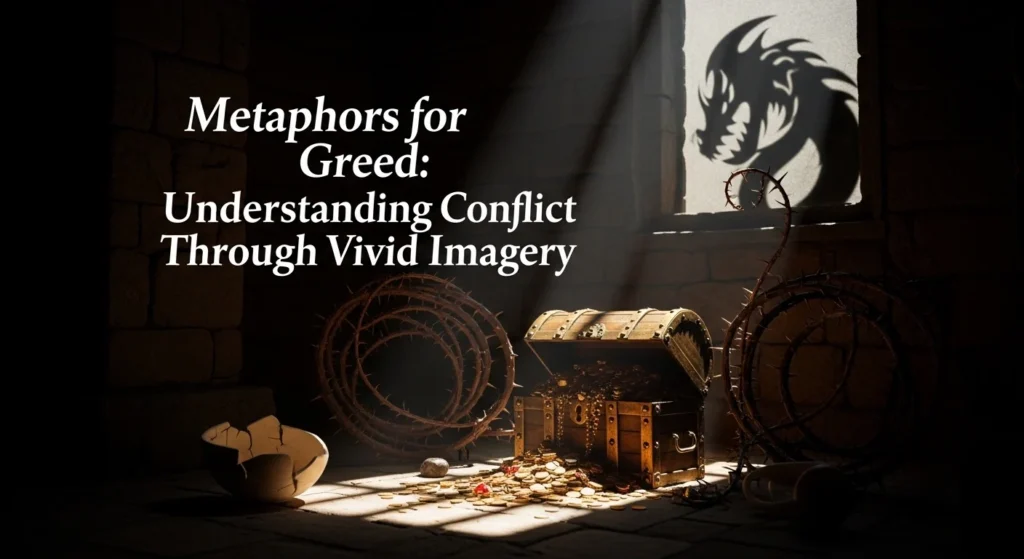
Conflict arises when desires, values, or goals clash. It can be emotional (jealousy between
friends), personal (inner struggles), professional (competition at work),
or social (inequality and power disputes). Yet greed—the intense and often excessive desire for more—can be difficult to
describe directly. This is where metaphors become powerful tools.
Metaphors transform abstract tension into images we can see and feel. When we describe greed as “a bottomless pit” or “a raging fire,” we make invisible emotions visible. These images
help readers and listeners understand not only what greed is, but how it behaves, spreads,
and harms relationships. Below are 22 carefully explained metaphors that illuminate greed in
personal and social conflicts.
1. Greed Is a Bottomless Pit
Meaning: Greed has no limit; it can never be fully satisfied. Example: His hunger for power was a bottomless pit that no promotion could fill. Alternatives: An endless void, an insatiable abyss, a hollow cave. Insight: This metaphor highlights emotional emptiness. It suggests that greed often grows from inner insecurity rather than real need.
2. Greed Is a Wildfire
Meaning: Greed spreads quickly and destroys everything in its path. Example: Corporate greed spread like wildfire, consuming trust among employees. Alternatives: A blazing inferno, a spreading flame, an uncontrollable blaze. Insight: Wildfires symbolize loss of control, showing how greed escalates conflicts rapidly.
3. Greed Is a Hungry Wolf
Meaning: Greed is predatory and relentless. Example: The hungry wolf of greed stalked every business deal he touched. Alternatives: A lurking predator, a ravenous beast, a stalking animal. Insight: This image captures aggression and instinct, revealing the survival-driven side of conflict.
4. Greed Is a Black Hole
Meaning: Greed absorbs everything without giving back. Example: The black hole of greed swallowed their once-happy partnership. Alternatives: A cosmic void, a consuming force, a gravitational trap. Insight: This metaphor suggests emotional and social collapse when greed dominates relationships.
5. Greed Is a Poison
Meaning: Greed slowly damages individuals and communities. Example: A poison of greed seeped into their friendship. Alternatives: Toxic influence, corrosive toxin, bitter venom. Insight: Poison emphasizes gradual harm, making it useful for describing subtle moral decline.
6. Greed Is a Leaking Bucket
Meaning: No matter how much one gains, satisfaction leaks away. Example: His ambitions were like a leaking bucket—never holding enough success. Alternatives: A cracked container, a broken vessel. Insight: This metaphor connects greed with futility and dissatisfaction.
7. Greed Is a Chain
Meaning: Greed traps and restricts freedom. Example: She was bound by the chain of greed, unable to enjoy what she had. Alternatives: Shackles of desire, golden handcuffs. Insight: Chains show how greed can enslave the person who pursues it.
8. Greed Is a Bottomless Stomach
Meaning: An endless appetite for more. Example: The company’s bottomless stomach devoured smaller competitors. Alternatives: Endless appetite, constant craving. Insight: This image connects greed with physical hunger, making it easy to visualize.
9. Greed Is a Storm
Meaning: Greed creates chaos and upheaval. Example: A storm of greed tore through the negotiations. Alternatives: Tempest of desire, whirlwind of ambition. Insight: Storms emphasize emotional turbulence and unpredictability.
10. Greed Is a Virus
Meaning: Greed spreads from person to person. Example: The virus of greed infected the entire organization. Alternatives: Contagion, epidemic of desire. Insight: This metaphor reflects how social environments can normalize selfish behavior.
11. Greed Is a Mirror That Never Reflects Enough
Meaning: Greed distorts self-perception and satisfaction. Example: The mirror of greed never reflected success clearly enough for him. Alternatives: Distorted reflection, warped glass. Insight: Highlights psychological dissatisfaction and comparison.
12. Greed Is a Snake in the Grass
Meaning: Greed hides and strikes unexpectedly. Example: A snake of greed lay hidden beneath his promises. Alternatives: Hidden serpent, silent threat. Insight: Suggests betrayal and hidden motives in conflict.
13. Greed Is a Ticking Time Bomb
Meaning: Greed eventually leads to explosive consequences. Example: Their unchecked greed was a ticking time bomb in the partnership. Alternatives: Delayed explosion, hidden trigger. Insight: Emphasizes long-term risk and inevitable fallout.
14. Greed Is a Shadow
Meaning: Greed follows a person constantly. Example: The shadow of greed trailed his every decision. Alternatives: Lingering darkness, constant presence. Insight: Shadows suggest subtle, ever-present influence.
15. Greed Is a Cage of Gold
Meaning: Wealth gained through greed traps rather than frees. Example: He lived in a golden cage built by greed. Alternatives: Gilded prison, shining trap. Insight: This metaphor shows the illusion of success masking emotional confinement.
16. Greed Is a Whirlpool
Meaning: Greed pulls others into destructive cycles. Example: The whirlpool of greed dragged the community into debt. Alternatives: Swirling vortex, pulling current. Insight: Suggests loss of control and collective harm.
17. Greed Is a Mask
Meaning: Greed hides behind noble intentions. Example: Charity became a mask for greed. Alternatives: False face, hidden agenda. Insight: Useful for highlighting hypocrisy.
18. Greed Is a Fire That Feeds on Itself
Meaning: The more one gains, the stronger greed becomes. Example: His ambition was a fire feeding on itself. Alternatives: Self-fueling blaze, growing flame. Insight: Shows how greed intensifies rather than diminishes over time.
19. Greed Is a Bottomless Wallet
Meaning: Financial gain never satisfies the greedy. Example: To her, money disappeared into a bottomless wallet. Alternatives: Endless purse, insatiable account. Insight: Connects greed to consumer culture and material obsession.
20. Greed Is a Thorn Bush
Meaning: Pursuing greed leads to pain and entanglement. Example: He found himself tangled in the thorn bush of greed. Alternatives: Briar patch, spiked hedge. Insight: Suggests consequences and self-inflicted suffering.
21. Greed Is a Heavy Crown
Meaning: The pursuit of power becomes burdensome. Example: The heavy crown of greed bent his shoulders. Alternatives: Burdened throne, weight of ambition. Insight: Reveals how leadership driven by greed can create stress and isolation.
22. Greed Is a Cracked Compass
Meaning: Greed distorts moral direction. Example: His cracked compass of greed led him astray. Alternatives: Broken guide, faulty moral map. Insight: Emphasizes ethical confusion and poor decision-making.
How to Use These Metaphors Effectively

In Writing
- Choose metaphors that match the tone (a “virus” works in social commentary; a “hungry
- wolf” suits storytelling).
- Avoid mixing too many metaphors in one passage.
- Use them to reveal emotion, not just decorate language.
In Speeches
- Select vivid, simple images your audience can visualize quickly.
- Repeat a central metaphor for emphasis (e.g., “We must stop the wildfire of greed.”).
- Pair metaphor with a solution to guide listeners toward resolution.
In Everyday Communication
- Use metaphors gently in personal conflicts (“It feels like we’re caught in a whirlpool of wanting more”).
- Avoid accusatory imagery when emotions are high.
- Focus on shared understanding rather than blame.
Famous Uses of Conflict Metaphors
Writers and leaders have long used metaphors to describe destructive desires. In Macbeth by
William Shakespeare, unchecked ambition (a form of greed) acts like a consuming force
that destroys trust and sanity. Similarly, Animal Farm by George Orwell* uses farm imagery to
expose political greed and corruption. These works demonstrate how metaphor sharpens moral insight and makes abstract flaws unforgettable.
Frequently Asked Questions (FAQ)
1. Why use metaphors instead of plain language?
Metaphors make emotions easier to imagine. They create mental pictures that stick in memory.
2. Are metaphors always negative when describing greed?
Not necessarily. They can also show internal struggle or societal pressure without attacking a
person directly.
3. Can I create my own metaphor for greed?
Yes. Effective metaphors connect greed to something familiar—nature, objects, or physical sensations.
4. How do I avoid exaggeration?
Choose imagery that fits the situation. A “wildfire” may be too strong for minor disagreement.
5. Do metaphors help resolve conflict?
They can. By describing tension symbolically, people may discuss the issue more calmly and thoughtfully.
Conclusion
Metaphors shape how we see conflict. When greed is described as a wildfire, a chain, or a
cracked compass, it becomes more than a moral flaw—it becomes a vivid force with consequences. These images deepen understanding, build empathy, and encourage reflection. For students, writers, and speakers alike, mastering metaphors for greed offers a
powerful way to transform abstract tension into meaningful insight—and, ultimately, into
wiser conflict resolution.