
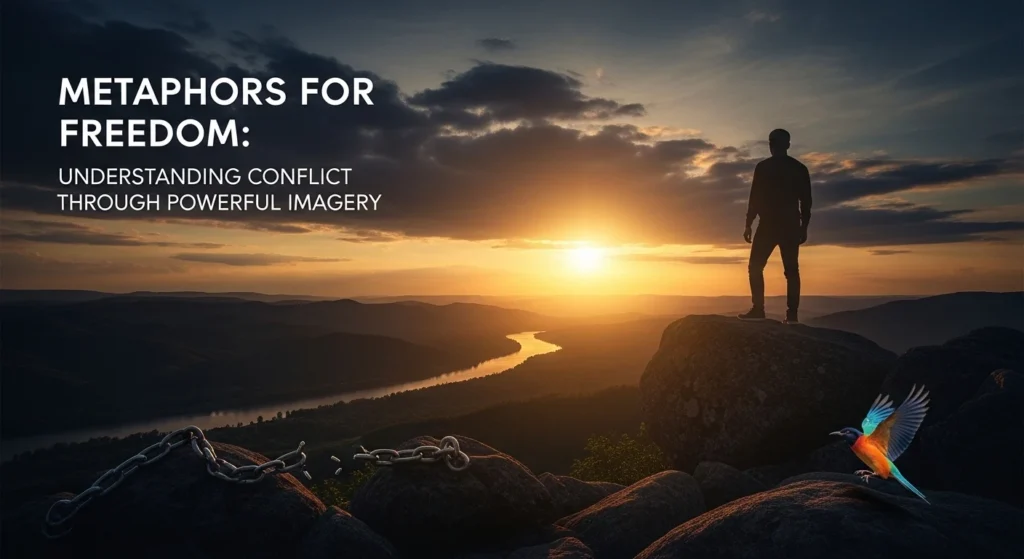
Conflict is the tension that arises when needs, desires, values, or goals collide.
It can exist within a person’s mind, between individuals, inside workplaces, or across
societies. Yet conflict is often abstract—it feels heavy, confusing, or invisible. That’s where metaphors become powerful.
Metaphors translate emotional and social tension into vivid, relatable images. They turn “feeling restricted” into “wearing chains,” or “seeking independence” into “spreading wings.”
By giving shape to invisible struggles, metaphors help us better understand freedom—not
just as a political idea, but as an emotional, personal, professional, and social
experience.
Below are 22 carefully crafted metaphors for freedom, each with meaning, example,
alternatives, and insight into its emotional relevance.
1. Breaking the Chains
Meaning: Escaping control, limitation, or oppression. Example: After years in a toxic job, she finally broke the chains and started her own business. Alternatives: Shattering restraints, removing shackles, cutting loose. Insight: This metaphor captures the emotional weight of
restriction and the relief of release, making personal liberation feel tangible and dramatic.
2. Spreading Your Wings
Meaning: Gaining independence and confidence. Example: Moving to another city helped him spread his wings. Alternatives: Taking flight, finding your sky, leaving the nest.
Insight: The image of flight suggests growth and courage, reflecting the natural human
desire to explore beyond limitations.
3. A Bird Out of a Cage
Meaning: Feeling liberated after confinement. Example: After graduation, she felt like a bird out of a cage. Alternatives: Released into the wild, freed from enclosure. Insight: Confinement versus open air highlights the contrast between restriction and possibility.
4. Open Road Ahead
Meaning: Unlimited opportunity and autonomy. Example: With no debt and no obligations, he felt the open road ahead. Alternatives: Endless highway, clear path forward. Insight: Roads symbolize life’s direction. An open one implies choice and self-determination.
5. Cutting the Strings
Meaning: Escaping manipulation or control. Example: She cut the strings that tied her to others’ expectations. Alternatives: Breaking free from control, ending puppet strings. Insight: The puppet image highlights psychological freedom from pressure and influence.
6. Unchained Mind
Meaning: Freedom of thought and belief. Example: Education gave him an unchained mind. Alternatives: Free thinker, liberated thoughts. Insight: Mental freedom often precedes social change; this metaphor emphasizes intellectual independence.
7. Fresh Air After a Storm
Meaning: Relief after conflict or hardship. Example: Signing the peace agreement felt like fresh air after a storm. Alternatives: Calm after chaos, sunshine after rain. Insight: Freedom here is emotional release—moving from tension to calm clarity.
8. Unlocked Door
Meaning: Opportunity newly available. Example: The scholarship unlocked doors she never imagined. Alternatives: Open gateway, lifted barrier. Insight: Doors represent access. Unlocking one symbolizes new beginnings and mobility.
9. Breaking the Mold
Meaning: Escaping conformity. Example: He broke the mold by choosing art over engineering. Alternatives: Defying norms, rewriting expectations. Insight: This metaphor reflects identity freedom—the courage to be different.
10. Light Through the Bars
Meaning: Hope and partial liberation. Example: The reform bill was light through the bars for citizens. Alternatives: Glimmer of hope, ray of freedom. Insight: Even small freedoms can feel transformative during restriction.
11. Casting Off Anchors
Meaning: Letting go of burdens that prevent progress. Example: She cast off anchors of self-doubt. Alternatives: Releasing weight, lifting the anchor. Insight: Anchors suggest stagnation; removing them signals forward movement.
12. Tearing Down Walls
Meaning: Removing barriers between people or ideas. Example: Open dialogue tore down walls between communities. Alternatives: Breaking barriers, dismantling divisions. Insight: Walls symbolize separation; their removal suggests unity and social freedom.
13. A Blank Canvas
Meaning: The freedom to create your own future. Example: Retirement gave him a blank canvas. Alternatives: Fresh start, clean slate. Insight: Freedom can feel both exciting and
intimidating, like facing empty space full of possibility.
14. Rising from the Ashes
Meaning: Rebuilding after destruction or limitation. Example: The nation rose from the ashes after independence. Alternatives: Reborn anew, renewed strength. Insight: Freedom often follows hardship, making resilience central to liberation.
15. Crossing the Finish Line
Meaning: Achieving long-sought relief or release. Example: Paying off her loans felt like crossing the finish line. Alternatives: Completing the race, reaching the summit. Insight: Freedom can be earned through endurance, making it deeply satisfying.
16. A Window to the World
Meaning: Access to broader perspectives. Example: The internet became a window to the world. Alternatives: Opening horizons, widening views. Insight: Knowledge expands freedom by reducing ignorance and isolation.
17. Walking Out of the Shadows
Meaning: Stepping into authenticity. Example: He walked out of the shadows and embraced his identity. Alternatives: Stepping into the light, claiming visibility. Insight: Personal freedom often involves courage to be seen.
18. Shedding Old Skin
Meaning: Transforming into a freer version of oneself. Example: Therapy helped her shed old skin. Alternatives: Renewing oneself, personal rebirth. Insight: This metaphor emphasizes psychological growth and healing.
19. Untying the Knot
Meaning: Resolving complicated restrictions. Example: Honest conversation untied the knot in their relationship. Alternatives: Loosening ties, unraveling tension. Insight: Conflict feels tight and constricted; freedom feels loosened and open.
20. Opening the Floodgates
Meaning: Releasing suppressed feelings or expression. Example: The verdict opened the floodgates of celebration. Alternatives: Letting it pour, emotional release. Insight: Suppression builds pressure; freedom allows natural emotional flow.
21. Stepping Into the Sunlight
Meaning: Experiencing clarity and openness. Example: Whistleblowing felt like stepping into the sunlight. Alternatives: Emerging into light, standing in daylight. Insight: Light symbolizes truth and transparency—core elements of freedom.
22. The Sky Is the Limit
Meaning: Boundless opportunity. Example: With her new degree, the sky is the limit. Alternatives: Endless possibilities, no ceiling. Insight: This metaphor inspires optimism and ambition, linking freedom to potential.
How to Use Freedom Metaphors Effectively
In Writing
- Use metaphors to simplify complex emotional conflicts.
- Match the metaphor to the audience’s experience.
- Avoid mixing incompatible images (e.g., chains and ocean waves in one sentence).
In Speeches
- Choose vivid, relatable imagery to inspire action.
- Repeat a central metaphor to build emotional rhythm.
In Everyday Communication
- Use simple metaphors to express feelings clearly.
- For example, saying “I feel tied down” communicates frustration quickly and naturally.
The key is moderation and clarity. A well-chosen metaphor illuminates; too many can confuse.
Famous Uses of Freedom and Conflict Metaphors
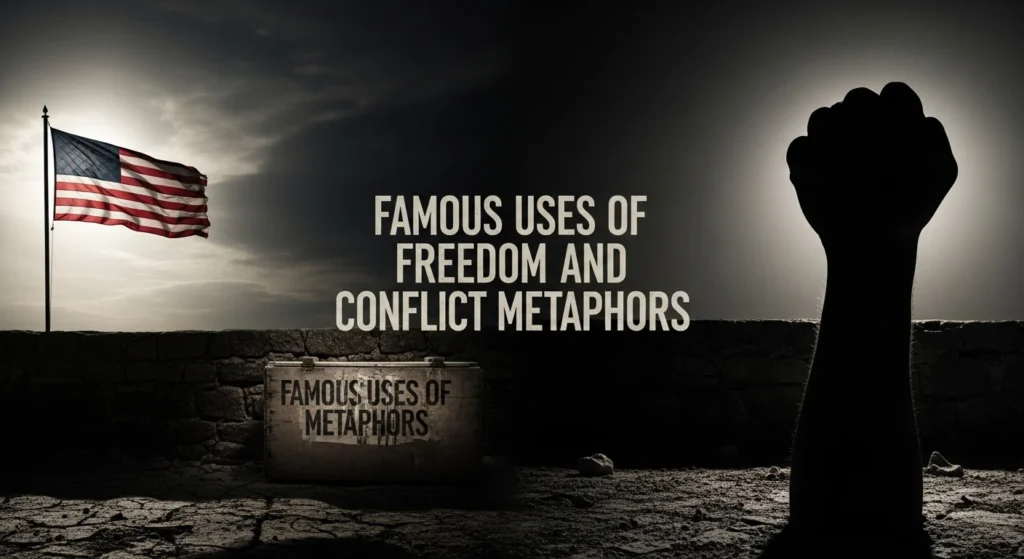
Many leaders and writers have relied on freedom metaphors:
- “I Have a Dream” speech by Martin Luther King Jr. uses imagery of chains and freedom to
- express civil rights struggles.
- In “Letter from Birmingham Jail,” King contrasts imprisonment with moral freedom.
- Nelson Mandela often described apartheid as chains that needed breaking.
- In literature, Maya Angelou uses the caged bird as a symbol of constrained freedom in I
- Know Why the Caged Bird Sings.
These examples show how metaphors transform political and social conflict into emotionally
powerful imagery.
Frequently Asked Questions (FAQ)
1. Why are metaphors important when talking about freedom?
They make abstract ideas easier to understand and feel.
2. Can metaphors influence how people see conflict?
Yes. The images we use shape how we interpret struggles and solutions.
3. Are freedom metaphors only political?
No. They apply to personal growth, workplace change, relationships, and emotional healing.
4. How many metaphors should I use in one piece?
Focus on one or two strong images for clarity.
5. Can a metaphor be misunderstood?
Yes. Choose imagery appropriate to your audience’s culture and context.
Conclusion
Metaphors for freedom do more than decorate language—they shape perception.
By turning invisible tension into vivid images—chains, wings, doors, sunlight—they help
us understand conflict more clearly and respond with empathy.
Whether describing personal growth, professional change, or social transformation, metaphors
give voice to our deepest struggles and hopes. When chosen carefully, they not only explain freedom—they help people feel it.