
Failure is one of the most universal human experiences, yet it remains one of the hardest to describe directly. Saying “I failed” feels blunt, emotional, and sometimes even discouraging. That’s where language steps in to soften, explain, and reframe the experience. Throughout history, people have used metaphors for failure to give meaning to setbacks—turning painful moments into images we can understand, reflect on, and even learn from.
We often hear phrases like “I hit a wall,” “I fell short,” or “I was knocked down.” These are not just expressions—they are mental pictures that help us process disappointment. Metaphors allow us to step back from failure and see it as something navigable rather than final.
This article explores the most powerful metaphors for failure, their psychological meaning, cultural context, and how they shape the way we think about success and growth.
1. A Fallen House of Cards
Meaning: A fragile plan that collapses easily. Example: “When the funding was withdrawn, his startup became a fallen house of cards.” Alternatives: A fragile structure, a shaky foundation. Insight: Highlights the danger of building ambitions without stability.
2. Hitting a Brick Wall
Meaning: Encountering an obstacle that stops progress. Example: “After months of negotiations, we hit a brick wall.” Alternatives: Reached a dead end, met stiff resistance. Insight: Captures frustration and immobility in personal or professional conflicts.
3. A Sinking Ship
Meaning: A failing venture beyond rescue. Example: “He resigned before the company became a sinking ship.” Alternatives: Going under, falling apart. Insight: Suggests urgency and inevitable loss if action isn’t taken.
4. A Missed Train
Meaning: A lost opportunity. Example: “Skipping the interview felt like missing the train of my career.” Alternatives: Letting a chance slip away, missing the boat. Insight: Emphasizes regret and the fleeting nature of opportunity.
5. A Cracked Mirror
Meaning: Damaged self-image after failure. Example: “Failing the exam left her confidence like a cracked mirror.” Alternatives: Shattered confidence, broken self-esteem. Insight: Reflects internal emotional conflict and fractured identity.
6. A Burned Bridge
Meaning: Destroyed relationships or opportunities. Example: “His harsh words burned the bridge with his mentor.” Alternatives: Severed ties, closed doors. Insight: Shows how failure can affect trust and connection.
7. A Deflated Balloon
Meaning: Lost enthusiasm or hope. Example: “After the rejection, he felt like a deflated balloon.” Alternatives: Lost momentum, drained spirit. Insight: Conveys emotional exhaustion following disappointment.
8. A Stormed-Out Sea
Meaning: Chaotic aftermath of failure. Example: “The project ended in a stormed-out sea of confusion.” Alternatives: Turbulent collapse, chaotic breakdown. Insight: Suggests emotional upheaval and uncertainty.
9. A Broken Compass
Meaning: Loss of direction. Example: “Without guidance, her career felt like a broken compass.” Alternatives: Lost path, wandering aimlessly. Insight: Points to confusion that often follows setbacks.
10. A Collapsed Bridge
Meaning: Failed connection or transition. Example: “The deal’s collapse was like a bridge falling into the river.” Alternatives: Failed link, broken pathway. Insight: Symbolizes disrupted progress between stages of growth.
11. A Flickering Candle
Meaning: Fading hope. Example: “With every rejection, his optimism flickered like a candle in wind.” Alternatives: Dying light, fading spark. Insight: Reflects vulnerability during emotional struggle.
12. A Crashed Plane
Meaning: Sudden, dramatic failure. Example: “The campaign crashed like a plane mid-flight.” Alternatives: Total collapse, dramatic downfall. Insight: Highlights shock and the impact of abrupt endings.
13. A Derailed Train
Meaning: Plans gone off course. Example: “Unexpected expenses derailed their wedding plans.” Alternatives: Off track, sidetracked. Insight: Suggests disruption rather than permanent defeat.
14. A Withered Plant
Meaning: Neglected potential. Example: “Without support, his talent withered like a dry plant.” Alternatives: Stunted growth, faded promise. Insight: Shows how failure may stem from lack of care, not lack of ability.
15. A Dead Battery
Meaning: Exhausted effort. Example: “By the end of the week, I felt like a dead battery.” Alternatives: Burned out, out of steam. Insight: Connects failure with burnout and depletion.
16. A Shattered Glass
Meaning: Irreversible damage. Example: “The scandal shattered his reputation like glass.” Alternatives: Broken beyond repair, fractured image. Insight: Emphasizes consequences that are difficult to undo.
17. A Lost Map
Meaning: Absence of guidance. Example: “After graduation, she felt she was navigating life with a lost map.” Alternatives: Directionless, without a guide. Insight: Captures the uncertainty that follows unmet expectations.
18. A Failed Harvest
Meaning: Effort without reward. Example: “Months of preparation ended in a failed harvest.” Alternatives: Fruitless labor, barren results. Insight: Shows disappointment when hard work yields little outcome.
19. A Crumbling Wall
Meaning: Gradual breakdown. Example: “Their partnership crumbled like an aging wall.” Alternatives: Slowly falling apart, deteriorating bond. Insight: Suggests failure as a process, not a single event.
20. A Closed Door
Meaning: Rejection or blocked opportunity. Example: “That rejection letter felt like a closed door.” Alternatives: Denied entry, turned away. Insight: Symbolizes barriers that require resilience to overcome.
21. A Shadow Overhead
Meaning: Lingering impact of past failure. Example: “His previous mistake cast a shadow over new opportunities.” Alternatives: Dark cloud, lingering doubt. Insight: Demonstrates how unresolved setbacks affect confidence.
22. A Fumbled Pass
Meaning: Missed execution at a critical moment. Example: “Forgetting the key statistic was like fumbling the pass in the final seconds.” Alternatives: Dropped the ball, missed the mark. Insight: Highlights performance anxiety and timing in professional or social settings.
How to Use These Metaphors Effectively
1. In Writing
- Choose metaphors that match tone: a “withered plant” suits reflective essays; a “crashed
- plane” suits dramatic narratives.
- Avoid mixing conflicting imagery (e.g., ship + train in one sentence).
- Use sparingly for clarity and emotional precision.
2. In Speeches
- Metaphors make complex failure relatable.
- Pair imagery with a hopeful transition (“The bridge collapsed, but we can rebuild it.”).
- Repeat a central metaphor for emphasis.
3. In Everyday Communication
- Use gentle metaphors in sensitive situations (“a temporary detour” instead of “a total
- collapse”).
- Encourage growth by reframing failure (“a missed train” suggests another will come).
Famous Uses of Conflict and Failure Metaphors
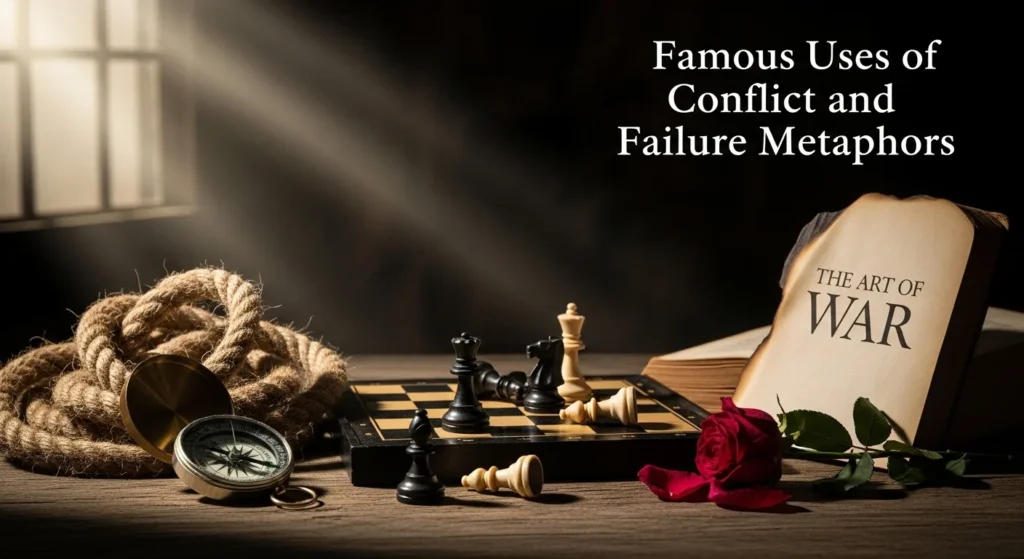
Writers and leaders have long relied on metaphor to express struggle and defeat:
- In Paradise Lost, John Milton describes the fall of humanity using cosmic battle
- imagery,
turning spiritual failure into epic conflict. - William Shakespeare frequently portrays ambition as a fragile structure—most notably in
- Macbeth, where unchecked desire leads to collapse.
- Abraham Lincoln, reflecting on civil strife, used imagery like a “house divided” to
- describe
national conflict—an enduring metaphor for instability.
These examples show how metaphor shapes collective understanding of loss and struggle.
fAQs
1. Why use metaphors instead of plain language?
Metaphors make emotions easier to visualize and understand. They connect abstract feelings to everyday experiences.
2. Can metaphors make failure seem dramatic?
Yes, if overused. Choose imagery that matches the real scale of the situation.
3. Are metaphors helpful in professional settings?
When used carefully, they clarify complex ideas and make presentations more memorable.
4. How do I create my own metaphor?
Compare your situation to something concrete. Ask: “What does this feel like?” Then refine the image.
5. Can metaphors improve emotional resilience?
Yes. Reframing failure as a “detour” instead
of a “dead end” changes mindset and encourages persistence.
Conclusion
Metaphors for failure are more than just linguistic tools—they are powerful ways of shaping how we understand setbacks, growth, and resilience. Whether we describe failure as falling, hitting a wall, taking a wrong turn, or simply being off track, each metaphor carries emotional meaning that influences how we respond to life’s challenges.
When used thoughtfully, these metaphors can transform failure from something final into something temporary, instructive, and even empowering. They remind us that setbacks are not endpoints but part of a larger journey of learning and growth.
Ultimately, the language we choose doesn’t just describe our experiences—it shapes them.