
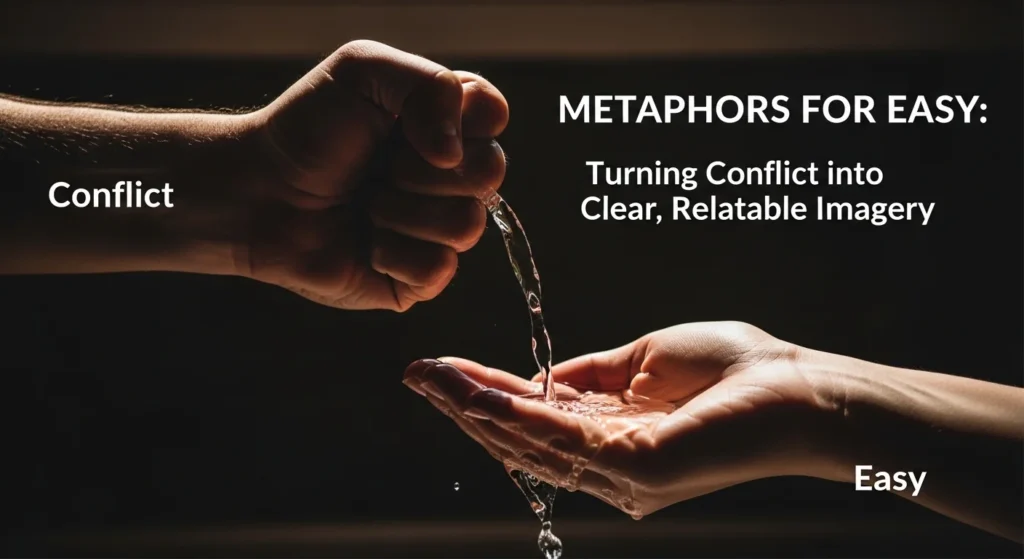
Conflict is the tension that arises when needs, values, goals, or expectations collide.
It can occur within a person (emotional conflict), between individuals (social conflict),
or inside workplaces and communities (professional conflict). While conflict is often abstract—
felt as stress, resistance, or uncertainty—metaphors help transform that invisible tension into
concrete images we can see and understand.
When we describe something as “a slippery slope” or “a storm brewing,” we translate emotional
complexity into vivid pictures. In the same way, metaphors for easy allow us to contrast struggle with effortlessness. They highlight relief, harmony, and resolution by painting conflict-
free situations as smooth paths, open doors, or gentle breezes. Below is a carefully structured
list of 22 metaphors for “easy,” each with meaning, example, alternatives, and insight
into its emotional relevance.
1. A Walk in the Park
Meaning: Something simple and stress-free. Example: “After weeks of preparation, the presentation felt like a walk in the park.” Alternatives: Effortless stroll, light outing. Insight:
This metaphor evokes calm and safety, contrasting with the tension of high-stakes conflict.
2. A Piece of Cake
Meaning: Very easy to accomplish. Example: “The math quiz was a piece of cake.” Alternatives: No sweat, child’s play. Insight: Associating ease with sweetness creates a positive emotional response, reducing anxiety.
3. Smooth Sailing
Meaning: Progress without obstacles. Example: “Once the team clarified roles, it was smooth sailing.” Alternatives: Clear waters, steady course. Insight: Suggests harmony and cooperation, often used after conflict resolution.
4. Like Riding a Bike
Meaning: Easy due to familiarity. Example: “Returning to coding after a break was like riding a bike.” Alternatives: Second nature, automatic. Insight: Highlights confidence and skill replacing earlier struggle.
5. A Breeze
Meaning: Extremely easy. Example: “The interview was a breeze once I relaxed.” Alternatives: Effortless, light work. Insight: Wind imagery suggests movement without resistance.
6. Plain Sailing
Meaning: Free from difficulty. Example: “After solving the budget issue, it was plain sailing.” Alternatives: Trouble-free, uncomplicated. Insight: Reinforces emotional relief following uncertainty.
7. Like Butter
Meaning: Smooth and without friction. Example: “The negotiation went like butter after we found common ground.” Alternatives: Silky smooth, frictionless. Insight: Implies harmony replacing previous tension.
8. Child’s Play
Meaning: So simple that even a child could do it. Example: “Fixing the bug was child’s play for the developer.” Alternatives: Easy as ABC, simple task. Insight: Suggests innocence and lack of complication.
9. A Snap
Meaning: Quick and easy. Example: “With the right tools, the repair was a snap.” Alternatives: Quick fix, done in no time. Insight: Conveys speed, reducing fear of prolonged conflict.
10. A Soft Landing
Meaning: A gentle transition without shock. Example: “The company’s restructuring turned out to be a soft landing.” Alternatives: Gentle shift, smooth transition. Insight: Reassures during change-related conflict.
11. Low-Hanging Fruit
Meaning: The easiest task available. Example: “Let’s tackle the low-hanging fruit first.” Alternatives: Quick win, easy gain. Insight: Encourages momentum in difficult situations.
12. Clear Skies
Meaning: No problems ahead. Example: “After the apology, it was clear skies between them.” Alternatives: Bright outlook, sunny path. Insight: Weather imagery symbolizes emotional calm.
13. Open Door
Meaning: An easy opportunity. Example: “The internship felt like an open door.” Alternatives: Golden chance, open path. Insight: Suggests accessibility and reduced barriers.
14. A Straight Line
Meaning: Direct and uncomplicated. Example: “The solution was a straight line once we understood the issue.” Alternatives: Direct route, clear path. Insight: Opposes the confusion of twists and turns.
15. Like Clockwork
Meaning: Perfectly smooth and predictable. Example: “The event ran like clockwork.” Alternatives: Seamless, flawlessly timed. Insight: Emphasizes order replacing chaos.
16. Light as a Feather
Meaning: Free from burden. Example: “After sharing her worries, she felt light as a feather.” Alternatives: Weightless, unburdened. Insight: Reflects emotional relief after resolving inner conflict.
17. A Gentle Stream
Meaning: Steady and calm progress. Example: “The discussion flowed like a gentle stream.” Alternatives: Smooth flow, easy current. Insight: Water imagery reflects emotional balance.
18. A Green Light
Meaning: Permission to proceed easily. Example: “We got the green light from management.” Alternatives: Go-ahead, approval. Insight: Removes hesitation and signals readiness.
19. A Clear Path
Meaning: No obstacles in the way. Example: “With everyone aligned, there was a clear path forward.” Alternatives: Open road, unobstructed way. Insight: Encourages optimism after disagreement.
20. Falling into Place
Meaning: Becoming easy as elements align. Example: “Once we talked honestly, everything fell into place.” Alternatives: Coming together, aligning smoothly. Insight: Shows harmony emerging from confusion.
21. A Silver Platter
Meaning: Given easily without effort. Example: “The opportunity was handed to him on a silver platter.” Alternatives: Gift-wrapped, effortlessly gained. Insight: Sometimes implies ease without struggle, which may cause resentment.
22. Coasting Downhill
Meaning: Moving forward with little effort. Example: “After the tough start, the project was coasting downhill.” Alternatives: Easy glide, downhill run. Insight: Suggests relief after initial resistance.
Using These Metaphors Effectively
In Writing
- Use metaphors to contrast tension and resolution.
- Avoid overusing common expressions; combine them with fresh context.
- Match the metaphor to the emotional tone (e.g., “storm” vs. “clear skies”).
In Speeches
- Choose simple, familiar metaphors to connect quickly with listeners.
- Use them to simplify complex problems or reassure audiences during change.
- Repeat key imagery for emphasis and clarity.
In Everyday Communication
- Replace abstract complaints (“It’s stressful”) with imagery (“It feels like pushing against
a wall”). - Use ease metaphors to reduce anxiety (“Don’t worry—it’s a breeze”).
- Be culturally aware—some metaphors may not translate well.
Famous Uses of Conflict Metaphors
Writers and leaders have long relied on metaphor to explain struggle and resolution. In Romeo
and Juliet, William Shakespeare portrays love as both “sweet” and “violent,” blending ease
and conflict in powerful imagery. Similarly, Martin Luther King Jr. famously described
injustice as a “storm” and hope as “sunlight,” turning social conflict into vivid natural
imagery. Such metaphors help audiences emotionally grasp abstract tensions and imagine peaceful solutions.
Frequently Asked Questions (FAQ)
1. Why use metaphors for something simple like “easy”?
Because metaphors add emotional depth. Saying “It was smooth sailing” feels more vivid than “It was easy.”
2. Can metaphors reduce conflict?
Yes. They help people see problems differently, often softening harsh emotions.
3. Are these metaphors suitable for academic writing?
Use them carefully. In formal essays, keep them limited and relevant.
4. How do I avoid clichés?
Pair familiar metaphors with specific details or create variations.
5. Do metaphors work in professional settings?
Absolutely—when used thoughtfully, they clarify ideas and inspire confidence.
Conclusion
Metaphors shape how we perceive difficulty and ease. By transforming abstract tension into
relatable imagery—storms into clear skies, obstacles into open doors—they help us
understand, communicate, and resolve conflict more effectively. Whether you are a student
explaining a challenge, a writer building emotional depth, or a professional guiding a
team through change, metaphors for “easy” can turn complexity into clarity. Ultimately, they
do more than decorate language—they shape empathy, perspective, and the path toward
resolution.