
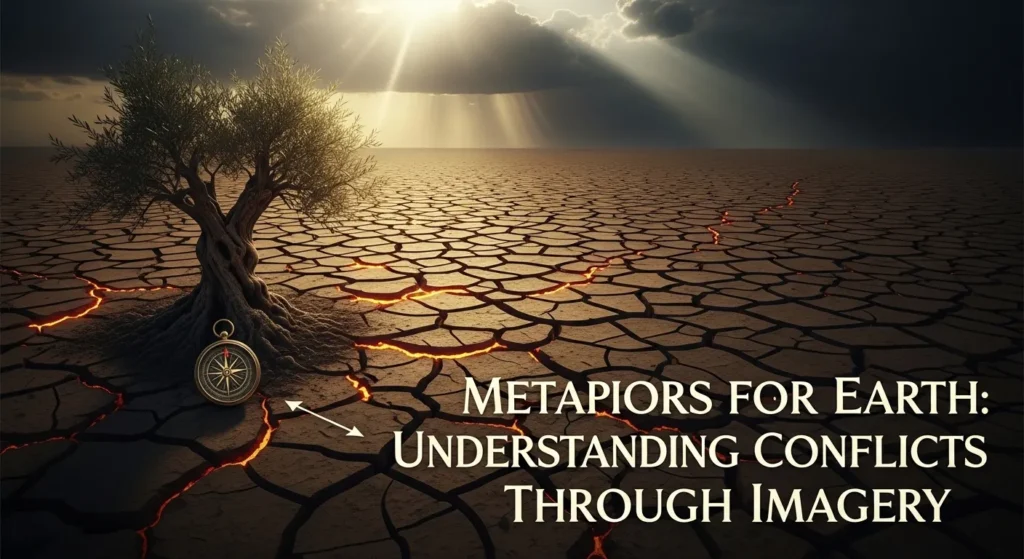
Conflict is an inherent part of human life.
It emerges in personal relationships, professional settings, and social structures, often bringing
tension, misunderstanding, and emotional strain. Yet, the human mind struggles to fully grasp
abstract experiences like disagreement, frustration, or ethical dilemmas. Metaphors act as
bridges between abstract feelings and concrete imagery, transforming invisible emotional
currents into vivid, relatable pictures. By likening conflict to aspects of the Earth—its
landscapes, forces, and rhythms—writers, speakers, and communicators can deepen
understanding, evoke empathy, and illuminate perspectives in ways plain description cannot.
Below is a curated list of 22 metaphors for Earth and their relevance to conflict. Each metaphor includes meaning, examples, alternative expressions, and emotional insight.
1. Earthquake
Meaning: Sudden, disruptive upheaval in life or relationships. Example: “Her harsh words
struck like an earthquake, shaking the foundation of our friendship.” Alternatives: Tremor, seismic shift, upheaval. Insight: Highlights the shock, unpredictability, and destabilizing effects of intense conflict.
2. Volcano
Meaning: Suppressed anger or tension that erupts violently. Example: “He’s been a quiet volcano for weeks; today, his frustration finally erupted.” Alternatives: Eruption, pressure cooker, lava flow. Insight: Captures both the buildup of emotion and the explosive
consequences of unchecked feelings.
3. Tectonic Plates
Meaning: Slow-moving forces that eventually cause major change or confrontation.
Example: “The generational differences in the company were like tectonic plates, shifting
imperceptibly until they cracked the team’s cohesion.” Alternatives: Underlying currents, hidden forces, foundational shifts. Insight: Emphasizes gradual, often unnoticed tension that can culminate in significant disruption.
4. Landslide
Meaning: Overwhelming or unstoppable force in conflict or public opinion. Example: “Criticism poured in like a landslide after the controversial decision.” Alternatives: Avalanche, deluge, surge. Insight: Reflects the emotional weight and momentum of collective pressure.
5. Sinkhole
Meaning: Sudden collapse or disappearance of stability. Example: “Trust in the partnership vanished overnight, leaving a sinkhole of uncertainty.” Alternatives: Abyss, collapse, void. Insight: Conveys shock, loss, and the hidden danger beneath seemingly stable relationships.
6. Erosion
Meaning: Gradual weakening or wearing away of relationships, values, or patience. Example: “Years of small arguments eroded the trust between them.” Alternatives: Wearing down, attrition, corrosion. Insight: Highlights the subtle, cumulative nature of conflict that can
undermine bonds over time.
7. Desert
Meaning: Emotional barrenness or isolation caused by conflict. Example: “After the betrayal, she felt like wandering a desert of loneliness.” Alternatives: Wasteland, void, barren land. Insight: Evokes feelings of emptiness, detachment, and the need for renewal.
8. Storm
Meaning: Turbulent, intense, and chaotic confrontation. Example: “Their debate turned into a storm of accusations and resentment.” Alternatives: Tempest, whirlwind, squall. Insight: Captures emotional intensity, confusion, and the energy of conflict.
9. Earth as a Battleground
Meaning: Conflict seen as a struggle for dominance, territory, or resources. Example: “Office politics turned the workplace into a battlefield.” Alternatives: Warzone, arena, combat zone. Insight: Frames conflict as strategic, high-stakes, and sometimes adversarial.
10. River Rapids
Meaning: Fast-moving, unpredictable situations requiring adaptability. Example: “Negotiations hit river rapids, forcing both sides to navigate carefully.” Alternatives: Whitewater, torrent, fast current. Insight: Suggests the need for flexibility, resilience, and focus in dynamic conflicts.
11. Quicksand
Meaning: Situations that trap or entangle people in escalating problems. Example: “Every attempt to fix the argument drew him deeper into quicksand.” Alternatives: Morass, bog, mire. Insight: Illustrates the danger of getting stuck or overwhelmed by complexity.
12. Earth’s Crust
Meaning: Surface-level appearances hiding deeper issues. Example: “The team’s calm
demeanor was just the Earth’s crust; underlying tensions were boiling below.” Alternatives: Veneer, facade, surface layer. Insight: Encourages looking beyond superficial harmony to understand root causes.
13. Mountain
Meaning: Obstacles or challenges that require effort to overcome. Example: “Reconciling their differences felt like climbing a mountain.” Alternatives: Peak, summit, high ground. Insight: Symbolizes endurance, patience, and the satisfaction of overcoming difficulty.
14. Canyon
Meaning: Emotional or relational gaps that are hard to bridge. Example: “A canyon of misunderstanding separated the two old friends.” Alternatives: Chasm, gulf, divide. Insight: Highlights distance, perspective, and the difficulty of connection.
15. Rock
Meaning: Stability or stubbornness in the face of conflict. Example: “He remained a rock during the team’s chaotic dispute.” Alternatives: Boulder, stone, bedrock. Insight: Can represent resilience or inflexibility, depending on context.
16. Soil Fertility
Meaning: Potential for growth or renewal after conflict. Example: “Their difficult conversation enriched the soil for a stronger partnership.” Alternatives: Groundwork, foundation, nurturing environment. Insight: Suggests that tension, if addressed, can cultivate understanding and growth.
17. Forest
Meaning: Complexity, interconnectedness, and hidden dangers. Example: “The company’s hierarchy was a dense forest of competing interests.” Alternatives: Jungle, woodland, thicket. Insight: Captures tangled relationships and the need for careful navigation.
18. Earth’s Core
Meaning: Deep-seated motivations or emotions fueling conflict. Example: “At the core of their argument was fear of losing control.” Alternatives: Heart, nucleus, center. Insight: Encourages looking beyond surface symptoms to fundamental drivers.
19. Mudslide
Meaning: Sudden, messy, and uncontrollable escalation. Example: “Rumors triggered a mudslide of accusations in the office.” Alternatives: Avalanche, cascade, flood. Insight: Shows how conflicts can quickly become chaotic and difficult to manage.
20. Plateau
Meaning: Stagnation or temporary pause in progress or resolution. Example: “Their negotiations hit a plateau, with no breakthroughs for weeks.” Alternatives: Flatland, high ground, level stretch. Insight: Reflects periods of calm, impasse, or reflection before further movement.
21. Earth as Canvas
Meaning: Opportunity to reshape, rebuild, or create new paths after conflict. Example: “After
the argument, they treated the reconciliation as painting a new canvas together.” Alternatives: Blank slate, foundation, workspace. Insight: Encourages constructive engagement, creativity, and renewal.
22. Cracks in the Earth
Meaning: Early signs of fracture or tension in relationships or systems. Example: “The first disagreement revealed cracks in their partnership.” Alternatives: Fissures, splits, fractures. Insight: Highlights warning signs and the importance of early intervention.
Using Earth Metaphors Effectively
- Writing: Employ these metaphors in novels, essays, and poetry to evoke imagery and
emotional resonance. - Speeches: Use metaphors to simplify complex issues, making abstract conflict more
relatable to audiences. - Everyday Communication: Metaphors can help articulate feelings, diffuse tension, and
create shared understanding in personal or professional conflicts. - Counseling and Therapy: Earth metaphors can provide a visual framework to discuss
emotional challenges, fostering insight and empathy.
Historical and Literary References

- William Golding’s Lord of the Flies uses the island as a metaphorical battleground,
showing how environmental forces mirror social conflict. - John Steinbeck’s The Grapes of Wrath employs dust and erosion to reflect economic and
social struggles. - Ancient fables and proverbs often compare storms, mountains, or rivers to human
challenges, illustrating timeless recognition of Earth’s metaphorical power.
FAQ
Q: Why are metaphors helpful in understanding conflict?
A: They turn abstract tension into tangible imagery, making emotions and dynamics easier
to grasp.
Q: Can I use multiple Earth metaphors at once?
A: Yes, but ensure they complement each other instead of creating confusion.
Q: Are Earth metaphors only for writing?
A: No, they work in speech, negotiation, teaching, therapy, and everyday conversation.
Q: How do I choose the right metaphor?
A: Consider the conflict’s intensity, duration, and emotional impact. Match the metaphor to the feeling or scenario.
Conclusion
Earth metaphors transform the invisible currents of conflict into vivid, comprehensible imagery. From sudden earthquakes to fertile soil, they reveal intensity, subtlety, potential for
growth, and the human experience of tension. By grounding abstract struggles in tangible
forms, metaphors not only clarify perception but also cultivate empathy and understanding—
turning conflict into an opportunity for insight, resolution, and connection.