
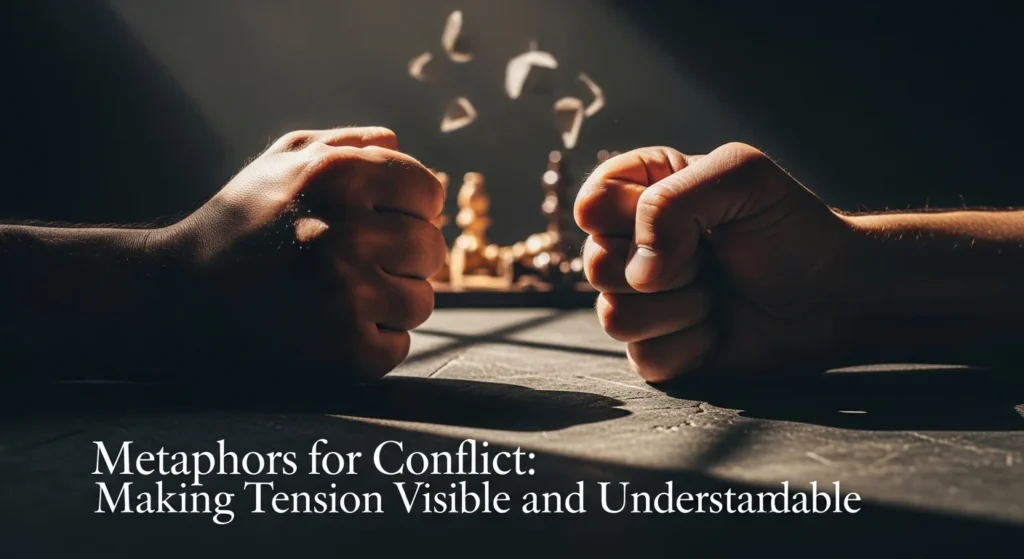
Conflict is a state of tension that arises when ideas, goals, values, or emotions collide.
It can occur within a person (inner doubt), between individuals (arguments), or among
groups (social or professional disputes). Because conflict is often abstract—felt as stress,
frustration, or opposition—it can be difficult to explain clearly.
That’s where metaphors become powerful. Metaphors translate invisible emotional friction into vivid, relatable imagery. They allow us to see disagreement as a storm, a tug-of-war, or a cracked mirror. By turning complex feelings into concrete pictures, metaphors deepen understanding, empathy, and communication.
Below are 22 carefully structured metaphors for conflict, each with meaning, example,
alternatives, and psychological insight.
1. A Storm Brewing
Meaning: Growing tension that has not yet exploded. Example: “There’s a storm brewing between the two departments.” Alternatives: Gathering clouds, rising thunder, darkening skies. Insight: This metaphor reflects anticipation and anxiety—people sense conflict before it fully
unfolds.
2. Walking on Thin Ice
Meaning: Being in a delicate or risky situation. Example: “After that comment, he knew he was walking on thin ice.” Alternatives: Treading carefully, skating on fragile ground. Insight: It highlights vulnerability and the fear of triggering escalation.
3. A Tug-of-War
Meaning: Two sides pulling in opposite directions. Example: “The negotiation became a tug-of-war over resources.” Alternatives: Push and pull, power struggle. Insight: Shows how conflict drains energy as each side resists compromise.
4. A Powder Keg
Meaning: A situation ready to explode at any moment. Example: “The political climate felt like a powder keg.” Alternatives: Time bomb, ticking fuse. Insight: Emphasizes suppressed anger and unpredictability.
5. A Battlefield
Meaning: A space of open, aggressive confrontation. Example: “The courtroom turned into a battlefield.” Alternatives: War zone, combat ground. Insight: Suggests high stakes and emotional intensity.
6. A Cracked Mirror
Meaning: A damaged relationship or trust. Example: “After the betrayal, their friendship became a cracked mirror.” Alternatives: Broken reflection, shattered glass. Insight: Symbolizes distortion—once trust breaks, perception changes.
7. A Knot That Won’t Untangle
Meaning: A complicated, unresolved problem. Example: “Their disagreement was a knot that wouldn’t untangle.” Alternatives: Tangled threads, twisted rope. Insight: Reflects frustration and mental strain.
8. A Fork in the Road
Meaning: A moment requiring a difficult decision. Example: “The company reached a fork in the road.” Alternatives: Crossroads, diverging paths. Insight: Focuses on choice and uncertainty rather than hostility.
9. Oil and Water
Meaning: Two incompatible personalities or ideas. Example: “They work together, but they’re oil and water.” Alternatives: Chalk and cheese, night and day. Insight: Suggests natural incompatibility rather than deliberate conflict.
10. A Volcano Ready to Erupt
Meaning: Suppressed anger about to explode. Example: “She was a volcano ready to erupt.” Alternatives: Boiling over, simmering rage. Insight: Captures the danger of bottling emotions.
11. A Tightrope Walk
Meaning: Maintaining balance between opposing sides. Example: “The manager performed a tightrope walk between teams.” Alternatives: Balancing act, walking a fine line. Insight: Shows the pressure of leadership in conflict.
12. A Shadow Between Us
Meaning: Lingering unresolved tension. Example: “There’s a shadow between us since that argument.” Alternatives: Silent barrier, invisible wall. Insight: Suggests emotional distance without open hostility.
13. A Game of Chess
Meaning: Strategic, calculated conflict. Example: “Their business rivalry is a game of chess.” Alternatives: Strategic duel, mind game. Insight: Emphasizes intelligence and planning over emotion.
14. A Broken Bridge
Meaning: Communication has collapsed. Example: “Without trust, the bridge between them broke.” Alternatives: Burned bridge, severed link. Insight: Reinforces the importance of connection.
15. A Pressure Cooker
Meaning: Stress building under confinement. Example: “The office became a pressure cooker during deadlines.” Alternatives: Boiling pot, mounting heat. Insight: Highlights emotional overload.
16. A Wall Between Us
Meaning: Emotional separation. Example: “After months of silence, a wall grew between them.” Alternatives: Emotional barrier, cold divide. Insight: Reflects isolation and disconnection.
17. A Fire That Spreads
Meaning: Conflict escalating quickly. Example: “The rumor was a fire that spread across the team.” Alternatives: Wildfire, blazing tension. Insight: Suggests how quickly misunderstandings grow.
18. A Fault Line
Meaning: Hidden weakness that can cause major conflict. Example: “Cultural differences formed a fault line in the organization.” Alternatives: Deep crack, underlying fracture. Insight: Implies long-term structural issues.
19. A Stalemate
Meaning: Neither side can win. Example: “Negotiations ended in a stalemate.” Alternatives: Deadlock, impasse. Insight: Shows exhaustion and frustration.
20. A Stormy Sea
Meaning: Emotional turbulence. Example: “His thoughts were a stormy sea.” Alternatives: Rough waters, turbulent tide. Insight: Conveys instability and confusion.
21. A Shattered Vase
Meaning: Irreversible damage. Example: “Trust shattered like a vase.” Alternatives: Broken pieces, fragmented bond. Insight: Highlights fragility in relationships.
22. A Cold War
Meaning: Silent but ongoing hostility. Example: “There’s a cold war between the partners.” Alternatives: Silent feud, icy tension. Insight: Reflects passive aggression and unspoken resentment.
Using Conflict Metaphors Effectively
In Writing
- Choose metaphors that match tone and genre.
- Avoid mixing too many images at once.
- Use metaphor to clarify emotion, not decorate unnecessarily.
In Speeches
- Metaphors make complex issues memorable.
- They help audiences emotionally connect.
- Use vivid but relatable imagery.
In Everyday Communication
- They soften difficult conversations.
- Instead of “You’re always angry,” say, “It feels like we’re in a pressure cooker lately.”
- They promote empathy by framing tension as shared experience.
Famous Uses of Conflict Metaphors
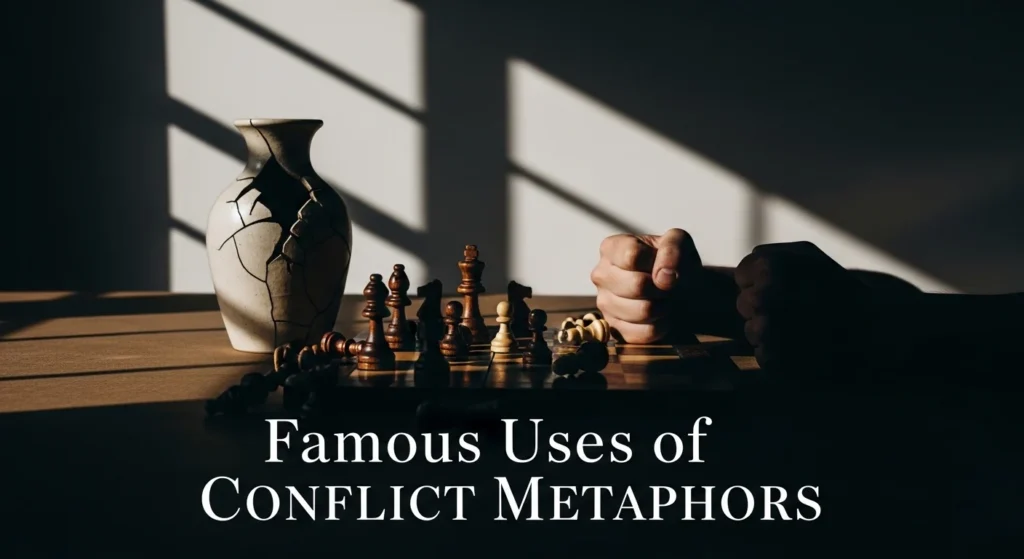
Writers and leaders have long used metaphors to express struggle:
- In Romeo and Juliet, family rivalry becomes a violent storm tearing lives apart.
- Martin Luther King Jr. described racial injustice as a “lonely island of poverty in the midst
of a vast ocean of prosperity.” - In The Art of War, conflict is framed as strategic warfare, shaping centuries of thinking
about competition and negotiation.
These metaphors endure because they make abstract struggle unforgettable.
Frequently Asked Questions (FAQ)
1. Why use metaphors for conflict?
They make abstract emotions easier to understand and discuss.
2. Can metaphors reduce tension?
Yes. A shared image often feels less accusatory than direct blame.
3. Are conflict metaphors always negative?
No. Some focus on choice (fork in the road) or strategy (game of chess), not hostility.
4. Should I use multiple metaphors at once?
Avoid mixing images in the same sentence—it can confuse readers.
5. Are metaphors suitable for professional settings?
Absolutely, if chosen carefully and kept respectful.
Conclusion
Conflict is part of human life—personal, professional, and social. Yet without language that captures its emotional texture, conflict remains vague and overwhelming. Metaphors transform tension into images we can see, feel, and understand. They shape perception, foster empathy, and open pathways toward resolution.
When we describe disagreements as storms, bridges, or knots, we are not just decorating
speech—we are reframing experience. And often, the way we frame conflict determines how we resolve it.