
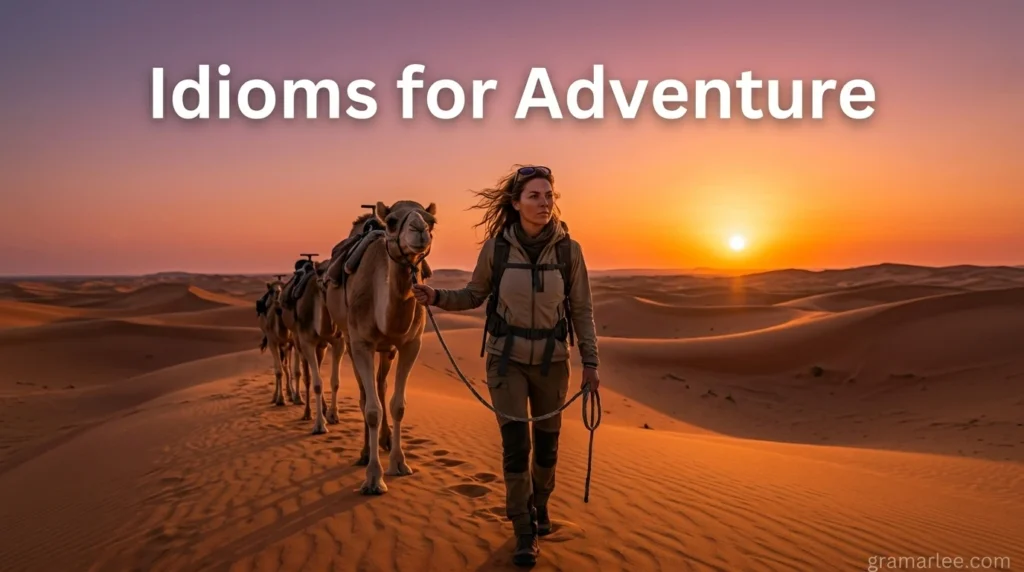
Adventure excites the human spirit. In English, idioms for adventure allow speakers to express exploration, risk-taking, curiosity, and the thrill of new experiences in vivid and engaging ways. These idioms help learners sound more fluent, creative, and expressive, whether sharing personal stories, writing essays, or communicating professionally.
By mastering adventure idioms, you can describe journeys, challenges, and life experiences more naturally and colorfully.Understanding and using adventure idioms has practical benefits: it improves storytelling, enhances conversation skills, and makes writing more engaging.
Emotionally, these idioms help convey excitement, courage, and curiosity, allowing speakers to connect with audiences on a deeper level. In real life, whether traveling, taking risks in business, or exploring new ideas, idioms for adventure help articulate your experiences clearly and memorably.
1) What “Idioms for Adventure” Means
Idioms for adventure are fixed expressions that describe exploration, risk-taking, bravery, or curiosity. Unlike literal expressions like “I went on an adventure,” idioms create imagery, emotion, and cultural context, helping learners communicate experiences with flair.
They appear in:
- Travel blogs and storytelling
- Business and innovation contexts
- Daily conversation and casual discussions
- Literature, movies, and media
2) Why Adventure Idioms Are Important
Adventure idioms are crucial because they:
- Enrich storytelling and creative writing
- Convey courage, risk, or curiosity naturally
- Help learners understand nuanced English expressions
- Make communication vivid and engaging
- Allow description of personal, professional, or imaginative journeys
They are valuable for students, travelers, storytellers, and professionals presenting ideas or describing challenges.
3) Core Adventure Idioms You Should Know
1. Bite the bullet
Meaning: face a difficult or risky situation bravely Example: I decided to bite the bullet and travel alone. Alternative expressions: take the plunge, face the music Use case: facing challenges, starting new experiences Fun fact/origin: Originates from battlefield practices where soldiers bit bullets to endure pain during surgery.
2. Take the plunge
Meaning: commit to a risky or exciting action Example: He finally took the plunge and started his own business. Alternative expressions: go for it, dive in Use case: new ventures, adventurous experiences
3. Throw caution to the wind
Meaning: act without worrying about risk Example: She threw caution to the wind and went skydiving. Alternative expressions: take risks, live boldly Use case: adventurous sports, bold decisions
4) Idioms for Exploration
1. Blaze a trail
Meaning: explore or create a new path Example: She blazed a trail in sustainable travel blogging. Alternative expressions: pioneer, lead the way Use case: career innovation, literal exploration
2. Go off the beaten track
Meaning: explore unusual or less-known places Example: We went off the beaten track to discover hidden beaches. Alternative expressions: explore, venture into the unknown Use case: travel, adventures in unfamiliar areas
3. Follow one’s nose
Meaning: explore or investigate instinctively Example: We followed our noses and found a charming little café. Alternative expressions: trust instincts, follow intuition Use case: discovery, casual adventures
5) Idioms for Risk and Bravery
1. On the edge
Meaning: in a risky or thrilling situation Example: The climbers were on the edge of the cliff, feeling exhilarated. Alternative expressions: high-risk, thrill-seeking Use case: extreme sports, life challenges
2. Throw oneself in at the deep end
Meaning: take on a new or difficult situation without preparation Example: She threw herself in at the deep end by joining the startup. Alternative expressions: dive in, face challenges Use case: career risks, bold personal decisions
3. Sail close to the wind
Meaning: take risks that are slightly dangerous or daring Example: His business decisions sail close to the wind but often pay off. Alternative expressions: take chances, walk a fine line Use case: entrepreneurship, adventurous actions
6) Idioms for Curiosity and Discovery
1. Keep one’s eyes peeled
Meaning: watch carefully for something interesting or important Example: Keep your eyes peeled for unusual wildlife on the hike. Alternative expressions: stay alert, be observant Use case: adventure trips, treasure hunts, exploration
2. Dig deeper
Meaning: investigate thoroughly or explore more information Example: We need to dig deeper to understand the local culture. Alternative expressions: explore further, research Use case: learning, investigative adventures
3. Leave no stone unturned
Meaning: explore every possibility to achieve a goal Example: They left no stone unturned in planning the perfect expedition. Alternative expressions: explore thoroughly, be exhaustive Use case: exploration, problem-solving
7) Idioms for Excitement and Thrill
1. Living on the edge
Meaning: living in an adventurous or risky way Example: He loves living on the edge by skydiving and mountain biking. Alternative expressions: thrill-seeker, risk-taker Use case: extreme sports, daring lifestyles
2. Heart in one’s mouth
Meaning: feeling intense excitement or fear Example: My heart was in my mouth when the rope snapped during climbing. Alternative expressions: nervous excitement, tense anticipation Use case: adventure sports, tense moments
3. Jump in with both feet
Meaning: commit completely to an adventure or project Example: She jumped in with both feet when she backpacked through Europe. Alternative expressions: dive in, fully commit Use case: travel, new experiences, business ventures
8) Idioms for Uncertainty and Surprise
1. Up in the air
Meaning: uncertain or undecided Example: Our plans for the expedition are still up in the air. Alternative expressions: undecided, uncertain Use case: adventure planning, travel decisions
2. In the dark
Meaning: unaware or uninformed about a situation Example: We were in the dark about the trail conditions. Alternative expressions: uninformed, clueless Use case: exploration, planning
3. Take by storm
Meaning: do something successfully or impressively Example: The new adventure park took the city by storm. Alternative expressions: dominate, impress Use case: success stories, adventurous achievements
9) Grouping Idioms by Context
For bravery/risk: bite the bullet, take the plunge, throw caution to the wind, sail close to the wind For exploration: blaze a trail, go off the beaten track, follow one’s nose, leave no stone unturned For curiosity/discovery: keep one’s eyes peeled, dig deeper For excitement/thrill: living on the edge, heart in one’s mouth, jump in with both feet For uncertainty/surprise: up in the air, in the dark, take by storm
Infographic suggestion: Mind map of idioms by emotion and context with icons for travel, risk, discovery, and excitement.
10) Common Mistakes to Avoid
- Using idioms literally instead of figuratively.
- Overusing adventurous idioms in formal writing.
- Confusing similar idioms (e.g., “take the plunge” vs. “bite the bullet”).
- Using idioms in inappropriate contexts (e.g., business formal emails).
- Translating idioms word-for-word from other languages.
11) Tips for Effective Use
- Learn idioms with context and examples.
- Group idioms by type: risk, curiosity, exploration, thrill, uncertainty.
- Practice using them in conversations, writing, and storytelling.
- Use visual aids such as flashcards or mind maps.
- Observe idioms in media and literature to understand natural usage.
12) Interactive Exercises
Exercise A: Fill in the blanks
- She decided to ______ the plunge and travel alone.
- We went ______ the beaten track to find hidden waterfalls.
- Keep your eyes ______ for interesting wildlife.
- He ______ the bullet and faced his fear of heights.
- The expedition plans are still ______ in the air.
Answers: 1. take, 2. off, 3. peeled, 4. bit, 5. up
Exercise B: Match idioms to meanings
- heart in one’s mouth
- leave no stone unturned
- sail close to the wind
- go off the beaten track
A. take daring risks B. explore thoroughly C. extreme excitement or fear D. explore unusual or hidden places
Answers: 1-C, 2-B, 3-A, 4-D
Exercise C: Multiple choice (Advanced)
Which idiom fits: He committed fully to the new adventure without hesitation. A. jump in with both feet B. bite the bullet C. blaze a trail Answer: A. jump in with both feet
13) Practical Applications
- Travel: describe experiences and discoveries vividly.
- Storytelling: enhance narrative with adventure idioms.
- Professional contexts: discuss risk-taking or innovative projects.
- Everyday life: express curiosity, boldness, and excitement.
14) Fun Facts and Origins
- Bite the bullet: battlefield pain management.
- Blaze a trail: literally creating new paths, metaphorically leading.
- Heart in one’s mouth: visceral reaction to fear or excitement.
- Take the plunge: diving or committing fully.
- Go off the beaten track: travel idiom from exploring remote paths.
FAQs
1. What are idioms for adventure?
Expressions that describe risk, exploration, curiosity, and thrill.
2. Why should I learn them?
They enrich storytelling, communication, and professional expression.
3. Which idiom means “face a difficult situation bravely”?
Bite the bullet.
4. Which idiom means “explore unusual or hidden places”?
Go off the beaten track.
5. Which idiom means “commit fully to something”?
Jump in with both feet.
6. Which idiom is used for thrilling or risky experiences?
Living on the edge.
7. Can these idioms be used in formal writing?
Some are suitable for professional contexts, but others are informal storytelling tools.
8. How can I remember them easily?
Group idioms by context, practice in sentences, and use visual aids.
9. Which idioms describe curiosity and discovery?
Keep one’s eyes peeled, dig deeper, leave no stone unturned.
10. Are adventure idioms only for travel?
No, they also apply to business, personal challenges, creative projects, and storytelling.
Conclusion
Idioms for adventure help learners communicate risk, exploration, curiosity, and excitement naturally. They enhance conversation, storytelling, professional communication, and writing. By mastering idioms for bravery, exploration, thrill, and curiosity, learners can describe experiences vividly and effectively.
Practice through exercises, grouping idioms by context, and real-life application. Using visual aids, flashcards, and storytelling improves retention. Adventure idioms not only enrich language skills but also make communication expressive, engaging, and memorable—perfect for learners, students, and professionals seeking fluency and flair.