
Introduction
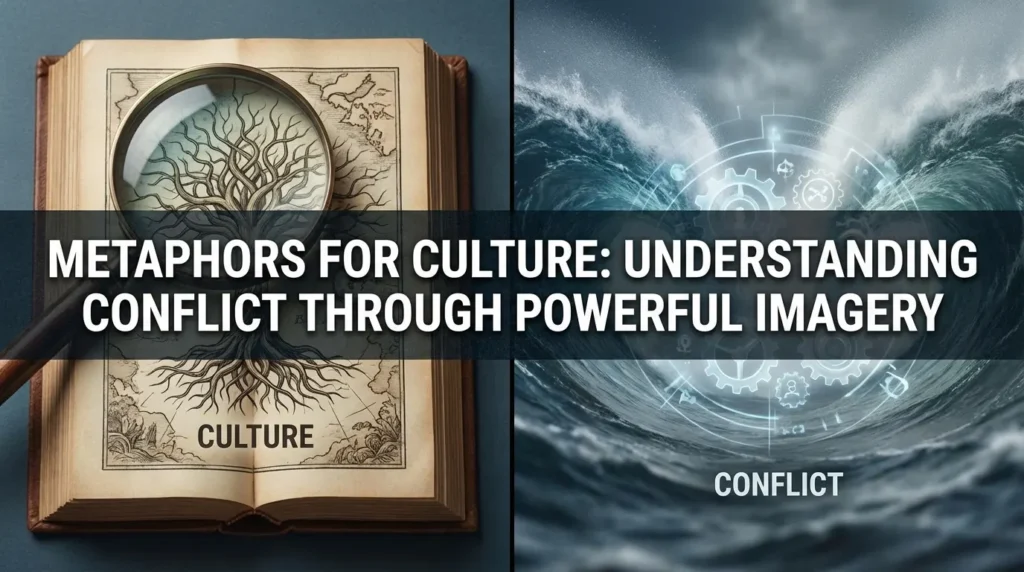
Conflict is a natural part of human experience. It emerges wherever differences exist—between values, identities, traditions, expectations, or goals.
Cultural conflict, in particular, can be complex because it involves deeply rooted beliefs,
social norms, and shared histories. These tensions are often abstract and emotionally layered,
making them difficult to explain directly.
Metaphors help bridge that gap. By transforming invisible tensions into vivid imagery,
metaphors allow us to “see” cultural conflict as something tangible: a bridge, a storm, a
crossroads, or even a battlefield. They do not merely decorate language; they reshape how we
understand emotional, personal, professional, and social clashes. Through metaphor, we turn
confusion into clarity and tension into something we can examine, discuss, and ultimately
resolve.
Below is a carefully structured list of 22 metaphors for culture and cultural
conflict, each with meaning, example, alternatives, and insight into its psychological relevance.
1. Culture as an Iceberg
Meaning: Most aspects of culture are hidden beneath the surface; visible behaviors are
only a small part.
Example: “When they argued about punctuality, they were really clashing over the iceberg
of culture beneath the surface.”
Alternatives: Hidden depths, submerged values, unseen layers
Insight: This metaphor highlights how misunderstandings often stem from invisible beliefs
and assumptions rather than obvious behaviors.
2. Culture as a Tapestry
Meaning: Culture is woven from many threads—languages, traditions, values, and histories.
Example: “The city’s cultural tapestry became strained when new traditions met old
expectations.”
Alternatives: Cultural fabric, woven heritage, interlaced identities
Insight: Emphasizes interconnectedness and the fragility of harmony when threads are pulled apart.
3. Culture as a Bridge
Meaning: Culture can connect different groups or perspectives.
Example: “Food became a bridge between their communities.”
Alternatives: Pathway, connector, link
Insight: Suggests that shared experiences can reduce emotional distance and foster empathy.
4. Culture as a Battlefield
Meaning: Cultural disagreements can feel like open conflict.
Example: “The debate over dress codes turned the office into a cultural battlefield.”
Alternatives: War zone, clash of values, front line
Insight: Reflects the intensity of identity-based disagreements and the emotional stakes involved.
5. Culture as a Garden
Meaning: Culture grows, evolves, and requires care.
Example: “Their multicultural team was a garden that needed patience to flourish.”
Alternatives: Ecosystem, fertile ground, living landscape
Insight: Encourages nurturing diversity rather than fearing it.
6. Culture as a Compass
Meaning: Culture guides behavior and decisions.
Example: “His cultural compass pointed him toward collective responsibility.”
Alternatives: Moral guide, internal map, value system
Insight: Shows how conflict arises when compasses point in different directions.
7. Culture as a Mirror
Meaning: Culture reflects identity and shared beliefs.
Example: “The festival was a mirror of the community’s history.”
Alternatives: Reflection, lens of identity
Insight: Conflicts can feel personal because culture mirrors who we are.
8. Culture as a Mosaic
Meaning: Culture is made of diverse, distinct pieces forming a whole.
Example: “The nation’s mosaic grew richer with each new tradition.”
Alternatives: Patchwork, collage, composite picture
Insight: Highlights diversity without demanding uniformity.
9. Culture as a Storm
Meaning: Cultural change can be turbulent and disruptive.
Example: “Globalization brought a storm of new ideas.”
Alternatives: Wave of change, whirlwind, upheaval
Insight: Validates the emotional turbulence people feel during rapid social shifts.
10. Culture as Roots
Meaning: Culture anchors identity and belonging.
Example: “She held tightly to her roots in a foreign land.”
Alternatives: Foundation, heritage, anchor
Insight: Explains why cultural conflict can feel like uprooting someone’s sense
of self.
11. Culture as a Lens
Meaning: Culture shapes how we interpret reality.
Example: “Through his cultural lens, direct criticism seemed disrespectful.”
Alternatives: Filter, perspective, worldview
Insight: Encourages awareness that disagreements may stem from differing interpretations.
12. Culture as a River
Meaning: Culture flows and adapts over time.
Example: “Traditions flowed like a river through generations.”
Alternatives: Current of history, stream of identity
Insight: Suggests flexibility and movement rather than rigidity.
13. Culture as a Shield
Meaning: Culture protects identity and values.
Example: “Language became a shield against assimilation.”
Alternatives: Armor, safeguard, protective layer
Insight: Shows defensive reactions during cultural threat.
14. Culture as a Puzzle
Meaning: Cultural understanding requires fitting pieces together.
Example: “Living abroad felt like solving a cultural puzzle.”
Alternatives: Complex equation, intricate design
Insight: Encourages patience and curiosity in conflict resolution.
15. Culture as a Script
Meaning: Culture provides unwritten rules for behavior.
Example: “He didn’t know the script for greeting elders.”
Alternatives: Social code, behavioral blueprint
Insight: Misunderstandings arise when people follow different scripts.
16. Culture as a Wall
Meaning: Cultural differences can create separation.
Example: “A wall of silence grew between generations.”
Alternatives: Barrier, divide, obstacle
Insight: Represents emotional distance and lack of dialogue.
17. Culture as a Marketplace
Meaning: Cultures exchange ideas and practices.
Example: “The internet became a global cultural marketplace.”
Alternatives: Exchange hub, crossroads
Insight: Emphasizes interaction and mutual influence.
18. Culture as a Flame
Meaning: Culture carries passion and tradition.
Example: “The elders kept the flame of tradition alive.”
Alternatives: Spark, torch, guiding light
Insight: Shows how cultural pride can inspire or ignite conflict.
19. Culture as a Compass Rose
Meaning: Culture offers multiple directional influences.
Example: “Her identity was shaped by many points on the cultural compass rose.”
Alternatives: Multidirectional guide, identity map
Insight: Reflects complexity in multicultural identities.
20. Culture as a Seed
Meaning: Culture plants ideas that grow over time.
Example: “Respect for elders was planted as a seed in childhood.”
Alternatives: Germ of tradition, starting point
Insight: Explains how early socialization shapes future conflicts.
21. Culture as a Stage
Meaning: Culture provides a setting where roles are performed.
Example: “In public, he stepped onto the cultural stage of formality.”
Alternatives: Social theater, performance space
Insight: Highlights pressure to conform to expected roles.
22. Culture as a Quilt
Meaning: Culture stitches together varied experiences into unity.
Example: “The community’s history formed a colorful quilt.”
Alternatives: Patchwork blanket, stitched narrative
Insight: Suggests warmth, belonging, and collective memory.
How to Use These Metaphors Effectively

In Writing
- Choose metaphors that match tone and audience.
- Avoid mixing too many images in one paragraph.
- Use metaphors to clarify—not complicate—ideas.
In Speeches
- Select emotionally resonant images like “bridge” or “garden” to inspire unity.
- Repeat a central metaphor for emphasis.
In Everyday Communication
- Use simple metaphors (“different lenses”) to reduce defensiveness.
- Frame disagreements as puzzles or bridges instead of battles.
Metaphors can soften conversations and create shared understanding, especially in culturally sensitive discussions.
Famous Uses of Conflict Metaphors
Throughout history and literature, metaphors have shaped how societies understand cultural conflict.
- In Things Fall Apart, Chinua Achebe uses the image of collapse to portray cultural
disruption during colonialism. - Martin Luther King Jr. often described injustice as a “storm” that must be weathered
together. - In The Clash of Civilizations, Samuel P. Huntington frames global politics as a
cultural clash, shaping decades of debate.
These examples show how metaphor can influence public perception and historical interpretation.
FAQ
1. Why are metaphors important in understanding culture?
They make abstract ideas concrete and easier to relate to emotionally.
2. Can metaphors oversimplify cultural conflict?
Yes, if used carelessly. Good metaphors clarify without reducing complexity.
3. Are some metaphors better for peaceful dialogue?
Yes. “Bridge,” “garden,” and “puzzle” encourage cooperation more than “battlefield.”
4. How can students use these metaphors in essays?
Introduce a metaphor early and consistently build your argument around it.
5. Do metaphors influence emotions?
Absolutely. They shape how we feel about an issue before we fully analyze it.
Conclusion
Metaphors are more than stylistic devices—they are tools of perception.
By turning cultural tension into bridges, storms, quilts, or puzzles, we make the
invisible visible. These images shape empathy, guide dialogue, and influence whether conflict
feels destructive or transformative. When used thoughtfully, metaphors help us navigate
cultural differences with clarity, compassion, and creativity—turning division into deeper
understanding rather than distance.