
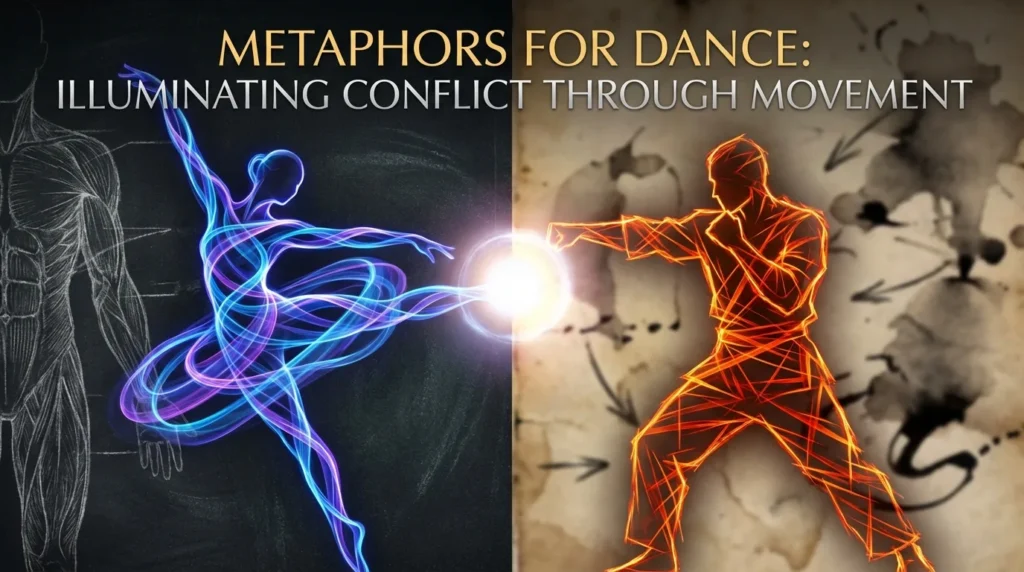
Conflict is a natural part of human experience.
It arises whenever values, desires, perspectives, or goals collide—within ourselves or between
people. Yet conflict can feel abstract and difficult to describe. This is where metaphors become powerful. By turning invisible emotional tension into vivid imagery, metaphors help us see and
feel conflict more clearly.
Dance, in particular, offers a rich source of metaphor. Dance involves rhythm, tension,
balance, coordination, missteps, and harmony—all elements that mirror emotional, personal,
professional, and social conflicts. When we describe conflict as a dance, we transform static
disagreement into something dynamic, relational, and deeply human.
Below are 22 carefully structured metaphors for dance that illuminate different dimensions of
conflict.
1. A Delicate Waltz
Meaning: A careful, sensitive interaction where each step must be measured. Example: Their negotiation was a delicate waltz, each word chosen with caution. Alternatives: A careful choreography, a graceful exchange. Insight: Suggests emotional fragility and mutual
awareness, often present in family or diplomatic tensions.
2. A Tug-of-War Tango
Meaning: A passionate but competitive exchange where both sides resist and advance. Example: Their debate became a tug-of-war tango, full of sharp turns and dramatic pauses. Alternatives: A push-and-pull routine, a dramatic duet. Insight: Reflects emotional intensity and power struggles within close relationships.
3. Stepping on Each Other’s Toes
Meaning: Miscommunication or unintended offense. Example: We keep stepping on each other’s toes during this project. Alternatives: Crossing wires, misaligned steps. Insight: Emphasizes how small mistakes can cause disproportionate irritation.
4. Dancing Around the Issue
Meaning: Avoiding direct confrontation. Example: They’ve been dancing around the issue instead of addressing it honestly. Alternatives: Skirting the topic, circling the problem. Insight: Highlights fear of vulnerability or discomfort.
5. A Choreographed Showdown
Meaning: A conflict that feels staged or predictable. Example: The political debate looked like a choreographed showdown. Alternatives: Scripted clash, rehearsed argument. Insight: Points to conflicts driven more by performance than resolution.
6. Out of Step
Meaning: Lack of harmony or alignment. Example: The manager seemed out of step with her team’s concerns. Alternatives: Out of sync, mismatched rhythm. Insight: Captures subtle disconnects that create tension.
7. A Slow Dance of Resentment
Meaning: Gradually building tension over time. Example: Their marriage turned into a slow dance of resentment. Alternatives: Lingering tension, simmering conflict. Insight: Suggests emotional accumulation rather than sudden explosion.
8. A Battle of Footwork
Meaning: Strategic maneuvering in conflict. Example: The lawyers engaged in a battle of footwork in court. Alternatives: Strategic sparring, tactical exchange. Insight: Emphasizes calculated movements and intellectual agility.
9. Changing the Rhythm
Meaning: Shifting the dynamic of a conflict. Example: She changed the rhythm of the conversation by speaking calmly. Alternatives: Resetting the tone, altering the pace. Insight: Suggests that emotional regulation can transform outcomes.
10. A Dance on Thin Ice
Meaning: Risky or fragile interaction. Example: Bringing up the budget cuts felt like a dance on thin ice. Alternatives: Walking a tightrope, navigating a minefield. Insight: Highlights fear of consequences.
11. A Spiral of Motion
Meaning: Conflict escalating in cycles. Example: Their arguments became a spiral of motion, repeating the same accusations. Alternatives: Escalating cycle, spinning out of control. Insight: Reflects repetitive patterns in unresolved disputes.
12. A Masked Ball
Meaning: Hidden motives in conflict. Example: The board meeting felt like a masked ball. Alternatives: Veiled intentions, hidden agendas. Insight: Suggests mistrust and lack of transparency.
13. Breaking the Formation
Meaning: Disrupting group unity. Example: His criticism broke the formation of the team. Alternatives: Disrupting harmony, shattering alignment. Insight: Highlights how individual dissent can destabilize systems.
14. A Solo Performance
Meaning: Facing conflict alone. Example: She handled the crisis like a solo performance. Alternatives: Standing alone, carrying the weight solo. Insight: Reflects isolation and personal responsibility.
15. A Dance of Shadows
Meaning: Subtle, indirect tension. Example: There was a dance of shadows between the rival departments. Alternatives: Quiet rivalry, unspoken tension. Insight: Suggests psychological undercurrents.
16. Finding the Beat Again
Meaning: Restoring harmony after disagreement. Example: After hours of discussion, they found the beat again. Alternatives: Regaining balance, restoring rhythm. Insight: Emphasizes reconciliation and shared timing.
17. A Clashing Flamenco
Meaning: Intense, expressive disagreement. Example: Their creative differences turned into a clashing flamenco. Alternatives: Fiery exchange, passionate clash. Insight: Connects emotion and pride to conflict.
18. Missing a Step
Meaning: Making an error that worsens tension. Example: He missed a step by ignoring her concerns. Alternatives: Miscalculated move, poor judgment. Insight: Highlights accountability.
19. A Frozen Stage
Meaning: Communication breakdown. Example: The negotiation reached a frozen stage. Alternatives: Deadlock, standstill. Insight: Suggests emotional paralysis.
20. A Circular Routine
Meaning: Repetitive, unresolved conflict. Example: Their discussions became a circular routine. Alternatives: Endless loop, repetitive cycle. Insight: Reflects frustration and stagnation.
21. An Improvised Routine
Meaning: Adapting to unexpected tension. Example: She turned the crisis into an improvised routine. Alternatives: Thinking on one’s feet, spontaneous adjustment. Insight: Suggests flexibility and resilience.
22. The Final Bow
Meaning: Closure or resolution. Example: Their apology marked the final bow of the dispute. Alternatives: Drawing the curtain, concluding act. Insight: Symbolizes dignity and emotional completion.
How to Use Dance Metaphors Effectively
In Writing
- Use them to make abstract emotions vivid.
- Match the metaphor’s tone to the emotional intensity.
- Avoid mixing too many movement-based metaphors in one passage.
In Speeches
- Choose familiar imagery like “out of step” or “finding the beat.”
- Pause after vivid metaphors to let the image settle.
In Everyday Communication
- Soften conflict by reframing it: “We’re just out of rhythm right now.”
- Use them to express vulnerability without accusation.
When used thoughtfully, these metaphors create empathy and shared understanding rather than defensiveness.
Conflict Metaphors in Literature and History
Writers and leaders have long used movement and dance imagery to portray tension.
In Romeo and Juliet by William Shakespeare, social encounters unfold like carefully
choreographed scenes, masking deeper hostility.
Similarly, in Pride and Prejudice by Jane Austen, ballroom dances mirror emotional
negotiations and shifting power dynamics between characters.
Historically, political rhetoric—such as speeches by Martin Luther King Jr.—often described
social struggle as coordinated movement toward justice, invoking rhythm and collective steps forward.
These examples show how dance metaphors can encode social tension and transformation.
FAQ
1. Why compare conflict to dance?
Because both involve interaction, timing, emotion, and movement. The metaphor makes conflict feel dynamic rather than static.
2. Are dance metaphors always positive?
No. They can express harmony or hostility, grace or chaos, depending on context.
3. Can these metaphors be used in academic writing?
Yes, if used sparingly and clearly to illustrate complex relational dynamics.
4. How do I avoid clichés?
Combine familiar phrases with specific context. For example, instead of simply saying “out of step,” explain what rhythm is being missed.
5. Do metaphors really help resolve conflict?
They can. By reframing tension as shared movement, they reduce blame and increase mutual understanding.
Conclusion
Conflict is rarely still; it moves, shifts, escalates, and resolves.
By describing it through the language of dance, we transform invisible tension into
visible choreography. Metaphors shape how we interpret disagreement—whether as combat,
chaos, or coordinated movement toward resolution.
When we see conflict as a dance, we recognize that resolution often requires timing,
balance, awareness, and shared rhythm. In this way, metaphors do more than decorate
language—they influence perception, deepen empathy, and open new pathways to
understanding and reconciliation.