
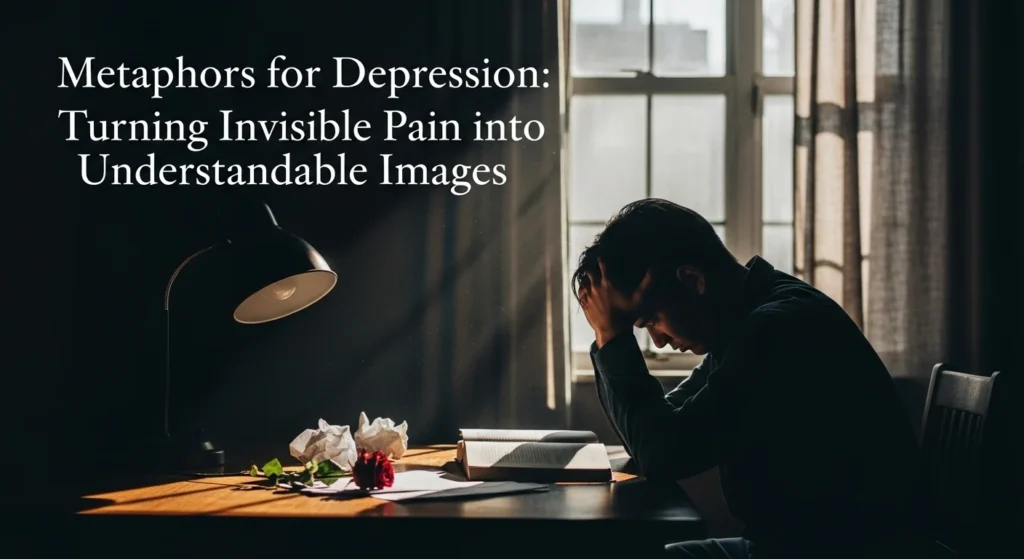
Depression is often described as a silent struggle—an internal conflict between the
desire to function and the weight that makes even simple tasks feel impossible.
Unlike physical wounds, emotional pain has no visible shape. That’s where metaphors become powerful.
Metaphors transform abstract tension into concrete imagery.
They help us see what cannot be seen, feel what is hard to explain, and understand experiences
that may otherwise remain distant or misunderstood. In conversations about emotional,
personal, professional, or social challenges, metaphors act as bridges between private suffering
and shared understanding.
Below are 22 carefully selected metaphors for depression. Each includes a meaning, a natural
example sentence, alternative expressions, and a brief insight into its psychological relevance.
1. A Dark Cloud
Meaning: A persistent sense of gloom hanging over someone. Example: “A dark cloud seems to follow him wherever he goes.” Alternatives: A gray sky overhead, a shadowed horizon. Insight: Suggests constant emotional heaviness and lack of brightness in daily life.
2. Carrying a Heavy Backpack
Meaning: Emotional burdens weighing someone down. Example: “Every day feels like carrying a heavy backpack filled with stones.” Alternatives: Emotional baggage, a sack of bricks. Insight: Emphasizes exhaustion and the invisible load others may not see.
3. Drowning in Silence
Meaning: Feeling overwhelmed but unable to express pain. Example: “She felt like she was drowning in silence.” Alternatives: Sinking beneath the surface, submerged in quiet. Insight: Captures isolation and the difficulty of asking for help.
4. Walking Through Thick Fog
Meaning: Mental confusion and lack of clarity. Example: “It’s like I’m walking through thick fog every morning.” Alternatives: Lost in a haze, clouded mind. Insight: Reflects cognitive symptoms such as difficulty concentrating.
5. An Empty Room
Meaning: Emotional numbness or absence of feeling. Example: “Inside, I feel like an empty room.” Alternatives: Hollow shell, vacant space. Insight: Highlights emotional disconnection rather than sadness alone.
6. A Broken Record
Meaning: Repetitive negative thoughts. Example: “My mind plays the same painful memories like a broken record.” Alternatives: Endless loop, stuck soundtrack. Insight: Points to rumination—a common depressive pattern.
7. A Black Hole
Meaning: A force that pulls in energy and hope. Example: “Depression feels like a black hole swallowing my motivation.” Alternatives: Emotional vacuum, endless void. Insight: Conveys the draining nature of depression.
8. Winter Without End
Meaning: A prolonged period of emotional coldness. Example: “It feels like winter without end.” Alternatives: Endless frost, perpetual cold season. Insight: Suggests loss of warmth, growth, and vitality.
9. A Flickering Candle
Meaning: Fragile hope struggling to stay alive. Example: “My hope feels like a flickering candle in the wind.” Alternatives: Dim light, fading spark. Insight: Recognizes vulnerability while acknowledging possibility of renewal.
10. A Locked Door
Meaning: Inability to access joy or connection. Example: “Happiness feels like a locked door I can’t open.” Alternatives: Sealed gate, closed window. Insight: Highlights frustration and emotional barriers.
11. Being Stuck in Quicksand
Meaning: Efforts to improve feel futile. Example: “The harder I try, the deeper I sink—like quicksand.” Alternatives: Trapped in mud, sinking ground. Insight: Expresses helplessness and loss of control.
12. A Heavy Blanket
Meaning: Overwhelming fatigue and lack of motivation. Example: “It’s like a heavy blanket is pressing me into the bed.” Alternatives: Crushing weight, thick cover. Insight: Captures physical symptoms of depression.
13. Living in a Shadow
Meaning: Feeling invisible or diminished. Example: “I feel like I’m living in a shadow of who I used to be.” Alternatives: Fading outline, dim reflection. Insight: Suggests identity loss and reduced self-worth.
14. A Cracked Mirror
Meaning: Distorted self-perception. Example: “Depression is like looking into a cracked mirror.” Alternatives: Warped reflection, shattered glass. Insight: Reflects negative self-image and cognitive distortion.
15. A Silent Storm
Meaning: Intense internal turmoil not visible externally. Example: “There’s a silent storm raging inside me.” Alternatives: Quiet hurricane, hidden tempest. Insight: Shows that suffering may be hidden behind calm behavior.
16. A Fading Photograph
Meaning: Loss of joy in memories or experiences. Example: “Happy memories feel like a fading photograph.” Alternatives: Washed-out picture, dim snapshot. Insight: Captures emotional blunting.
17. A Maze With No Exit
Meaning: Feeling trapped without solutions. Example: “It feels like I’m in a maze with no exit.” Alternatives: Endless labyrinth, closed corridors. Insight: Emphasizes hopelessness and confusion.
18. An Uncharged Battery
Meaning: Persistent low energy. Example: “No matter how much I rest, I’m like an uncharged battery.” Alternatives: Drained power, empty fuel tank. Insight: Connects emotional depletion with physical fatigue.
19. A Cracked Foundation
Meaning: Loss of stability in life. Example: “Depression feels like a crack in the foundation of my life.” Alternatives: Shifting ground, unstable base. Insight: Suggests impact on work, relationships, and identity.
20. A Deserted Island
Meaning: Profound loneliness. Example: “Even in a crowd, I feel like I’m on a deserted island.” Alternatives: Isolated shore, abandoned place. Insight: Highlights social disconnection.
21. A Tight Cage
Meaning: Feeling trapped by one’s own mind. Example: “My thoughts feel like a tight cage.” Alternatives: Mental prison, locked enclosure. Insight: Illustrates restriction and limited freedom.
22. A Dimmed Sun
Meaning: Loss of brightness in life. Example: “It’s as if the sun inside me has dimmed.” Alternatives: Faded light, muted glow. Insight: Suggests reduced joy but implies light still exists.
How to Use Depression Metaphors Effectively

1. In Writing
Metaphors deepen emotional storytelling. Instead of saying “He was sad,” describe the “heavy blanket” pressing him down. This creates vivid mental imagery.
2. In Speeches
Public speakers addressing mental health can use relatable images like “walking through fog”
to help audiences connect emotionally without clinical language.
3. In Everyday Communication
Metaphors allow people to explain feelings safely:
- “I feel like I’m stuck in quicksand” is clearer than “I’m struggling.” They encourage empathy because listeners can imagine the experience.
4. In Professional Settings
Leaders and HR professionals discussing burnout or morale may gently use metaphors like
“uncharged battery” to normalize conversations about emotional health.
Famous Uses of Emotional and Conflict Metaphors

Writers and leaders have long relied on metaphor to express internal struggle:
- In The Bell Jar by Sylvia Plath, depression is compared to being trapped under a bell jar—
- cut off from fresh air and clarity.
- William Shakespeare frequently used storm imagery to represent inner turmoil in plays
- like Macbeth.
- In Darkness Visible, William Styron described depression as a suffocating darkness.
These examples show how metaphor has long shaped our understanding of psychological conflict.
Frequently Asked Questions (FAQ)
1. Why use metaphors for depression?
Because depression is hard to describe directly. Metaphors make invisible feelings easier to understand.
2. Can metaphors replace medical explanations?
No. Metaphors help with communication, but clinical diagnosis and treatment require professional guidance.
3. Are metaphors helpful for someone experiencing depression?
Yes, many people find relief in language that captures their feelings accurately. It reduces isolation.
4. Can metaphors be harmful?
If exaggerated or used dismissively, they can minimize someone’s pain. Sensitivity matters.
5. Should I use the same metaphor for everyone?
No. Different people relate to different images. Choose metaphors that fit the individual’s experience.
Conclusion
Metaphors do more than decorate language—they shape perception. By describing depression
as fog, weight, storm, or shadow, we transform silent suffering into shared imagery. That transformation builds empathy, deepens understanding, and opens doors to meaningful conversations.
When we choose our metaphors carefully, we do more than explain conflict—we create
connection, clarity, and the possibility of healing.