
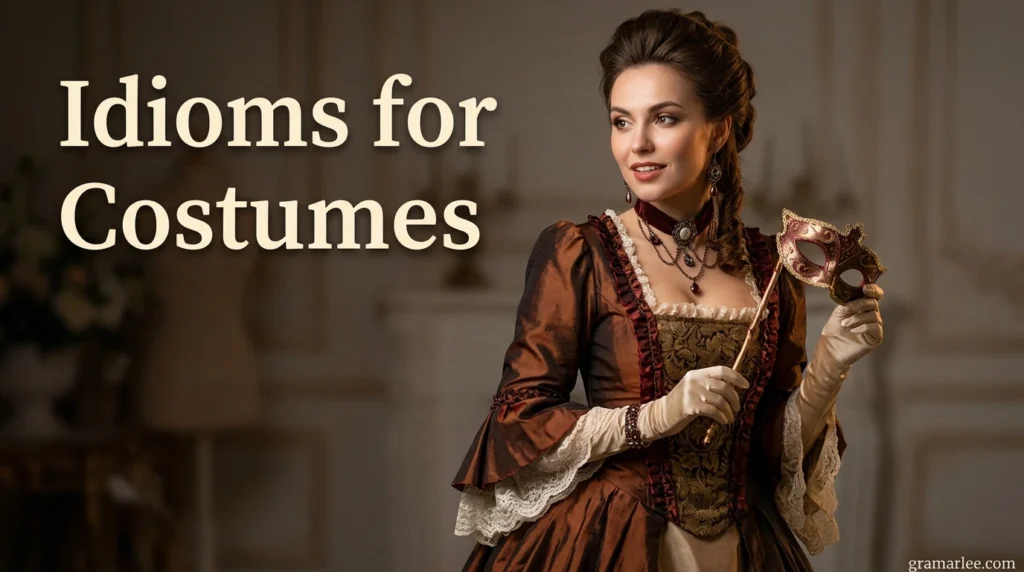
Costumes are more than clothes you wear for a party, stage performance, or holiday event. In English, they also inspire vivid idioms that help speakers describe identity, confidence, appearance, and hidden meaning. Learning idioms for costumes can make your English more natural, expressive, and memorable.
It also helps you understand movies, songs, workplace conversations, and everyday speech more easily. Most importantly, these expressions give you a practical way to sound fluent while adding a little fun to your vocabulary.
What “Idioms for Costumes” Really Means
When people search for idioms for costumes, they usually want English expressions connected to dressing up, disguises, appearances, roles, and the act of becoming “someone else” for a moment. Some of these idioms are directly related to costumes, while others are figurative phrases that use the idea of clothing or disguise.
For example, a literal costume is what you wear to look like a pirate, superhero, or movie character. An idiom, however, uses costume language to describe a deeper idea. Saying someone “wears many hats” does not mean they own many hats. It means they have many responsibilities.
Here are the main themes you will see in this article:
- dressing up and looking stylish
- hiding identity or pretending
- acting a role in public or at work
- changing perspective and understanding others
- making a strong impression in social situations
These expressions are useful for English learners because they appear in daily conversation, business English, entertainment writing, and casual speech.
Why English Learners Should Learn These Idioms
Idioms for costumes are useful for both communication and comprehension. They help you understand not only the words, but also the feeling behind them. That matters because English speakers often use figurative language to sound lively, humorous, or elegant.
When you know these idioms, you can:
- understand jokes, films, and social media captions more easily
- describe fashion, events, and personality in a richer way
- sound more confident in speaking and writing
- connect language with emotions and real-life situations
There is also an emotional benefit. Costume-related idioms often talk about transformation. They remind us that people can change roles, improve their image, or show different sides of themselves. That makes the topic especially interesting for students and professionals who want both vocabulary growth and cultural understanding.
Costume Idioms vs. Literal Costume Words
A common mistake is to read idioms too literally. English uses costume language in two different ways: literal and figurative.
A literal sentence is simple:
- “She wore a witch costume to the party.”
A figurative sentence uses an idiom:
- “She dressed to the nines for the party.”
The first sentence describes an actual costume. The second describes a very stylish appearance.
How to tell the difference
Ask yourself: does the sentence mean exactly what it says, or is it describing something indirectly?
For example:
- “in disguise” often means a real disguise, but it can also mean hidden intention
- “put on an act” is always figurative
- “dress up” can be literal or casual, depending on the context
Once you learn to spot the difference, costume idioms become much easier to use naturally.
Idioms for Dressing Up and Looking Sharp
These are some of the most common English idioms connected to costumes, fashion, and appearance. They are often used at parties, weddings, interviews, and special events.
1) Dressed to the nines
Meaning: dressed very elegantly or stylishly Example: “Everyone at the gala was dressed to the nines.” Alternative expressions: dressed elegantly, dressed perfectly, looking very smart Origin/fun fact: The exact origin is unclear. Many people think it may mean “perfect in every way,” because nine is a high number. Use case: formal events, weddings, celebrations
2) Dress to kill
Meaning: dress in a very attractive or striking way Example: “He dressed to kill for the company dinner.” Alternative expressions: dress impressively, dress to stand out Use case: fashion, dating, social events, parties
3) Suit someone to a T
Meaning: fit or suit someone perfectly Example: “That costume suits her to a T.” Alternative expressions: fit perfectly, look ideal, be just right Use case: clothing comments, design, style advice
4) Fit like a glove
Meaning: fit exactly and comfortably Example: “The jacket fit like a glove.” Alternative expressions: fit perfectly, fit just right Use case: clothes, shoes, costumes, custom-made items
These phrases are especially useful when talking about style, confidence, or how well something matches a person.
Idioms About Disguise and Hidden Identity
Costumes often hide identity, and English has many idioms for that idea. These expressions appear in stories, crime dramas, fantasy films, and everyday speech.
1) In disguise
Meaning: hidden behind a different appearance Example: “The detective entered the building in disguise.” Alternative expressions: hidden, undercover, masked Use case: stories, security, theater, jokes
2) Wear a mask
Meaning: hide your true feelings or identity Example: “She wears a mask of confidence, even when she feels nervous.” Alternative expressions: hide your emotions, cover up your true self Use case: emotional conversations, literature, psychology
3) A wolf in sheep’s clothing
Meaning: a dangerous person who seems harmless Example: “He seemed friendly, but he was a wolf in sheep’s clothing.” Alternative expressions: a fake friend, someone deceptive Origin/fun fact: This idiom comes from a well-known ancient fable. Use case: warnings, literature, business trust issues
4) Not what it seems
Meaning: something has a hidden truth Example: “The costume was fun, but the event was not what it seemed.” Alternative expressions: misleading, deceptive, hidden Use case: mystery stories, reviews, social situations
These idioms are powerful because they connect outer appearance with inner reality.
Idioms About Acting or Pretending
Costumes are often about playing a role, and English has many idioms for pretending or performing.
1) Put on an act
Meaning: behave in a fake or exaggerated way Example: “He puts on an act to impress people.” Alternative expressions: fake it, pretend, act false Use case: criticism, relationships, social behavior
2) Put on airs
Meaning: behave as if you are more important than others Example: “She started putting on airs after her promotion.” Alternative expressions: act superior, be snobbish Use case: social commentary, workplace conversations
3) Play a role
Meaning: act in a particular way for a purpose Example: “Parents often play a role in shaping children’s confidence.” Alternative expressions: take on a role, serve as, act as Use case: school, business, theater, family
4) Fake it till you make it
Meaning: act confident until confidence becomes real Example: “At first I was shy, but I fake it till I make it in presentations.” Alternative expressions: act confident, learn by doing Use case: interviews, public speaking, career growth
These idioms are especially helpful for professionals and learners who want to talk about confidence, performance, and social behavior.
Idioms About New Roles and Perspective
A costume can help someone become a new character. In English, that idea appears in idioms about role changes and empathy.
1) Step into someone’s shoes
Meaning: try to understand another person’s experience Example: “Before judging her, try to step into her shoes.” Alternative expressions: see it from their point of view, understand their situation Use case: communication, conflict resolution, leadership
2) Walk a mile in someone’s shoes
Meaning: understand another person by imagining their life Example: “It is easy to criticize, but harder to walk a mile in someone’s shoes.” Alternative expressions: show empathy, see their side Use case: social issues, education, counseling
3) Wear many hats
Meaning: have many responsibilities or roles Example: “At a small company, managers often wear many hats.” Alternative expressions: juggle several roles, handle many tasks Use case: work, startups, leadership, family life
4) Fill someone’s shoes
Meaning: take over a role that someone else performed well Example: “It will be hard to fill her shoes after she leaves.” Alternative expressions: replace someone, take over the job Use case: work transitions, leadership changes
These idioms are useful because they move beyond clothes and costumes into human understanding and responsibility.
Idioms for Confidence, Image, and First Impressions
Costumes often help people make a strong entrance. These idioms are perfect for talking about image, confidence, and presentation.
1) Look the part
Meaning: appear suitable for a role or situation Example: “He looks the part of a professional speaker.” Alternative expressions: seem appropriate, match the role Use case: interviews, theater, professional settings
2) Dress for success
Meaning: dress in a way that supports confidence and a positive image Example: “Many people believe you should dress for success at interviews.” Alternative expressions: dress professionally, present yourself well Use case: business, career advice, workplace culture
3) Turn heads
Meaning: attract a lot of attention Example: “Her costume turned heads at the festival.” Alternative expressions: stand out, catch everyone’s attention Use case: parties, fashion, public events
4) Make a statement
Meaning: show personality or confidence in a bold way Example: “That bright costume makes a statement.” Alternative expressions: stand out, express style strongly Use case: fashion, art, media, events
These expressions help learners describe not just clothes, but the effect clothes create.
Idioms for Parties, Halloween, and Theater
Some idioms for costumes are closely linked to entertainment, stage performance, and seasonal celebrations.
1) Costume party
Meaning: a party where people wear special outfits Example: “We are going to a costume party on Halloween.” Use case: holidays, birthdays, themed events
2) Dress up
Meaning: wear formal clothing or costume clothing Example: “Children love to dress up as superheroes.” Alternative expressions: put on a costume, get dressed formally Use case: Halloween, school events, playtime, theater
3) Steal the show
Meaning: get the most attention in a performance or event Example: “Her costume stole the show at the parade.” Alternative expressions: be the highlight, outshine everyone Use case: theater, concerts, public events
4) Break a leg
Meaning: good luck before a performance Example: “Break a leg in tonight’s school play!” Alternative expressions: good luck, do great Origin/fun fact: This is a classic theater expression, often used instead of saying “good luck” directly. Use case: acting, stage performances, auditions
These phrases make the topic more lively and help English learners understand cultural speech patterns.
Idioms Grouped by Context
One smart way to learn costume idioms is to group them by situation. That makes them easier to remember and use.
At work
Use idioms that sound professional:
- dress for success
- wear many hats
- fill someone’s shoes
- look the part
At school
Use idioms that support learning and social confidence:
- dress up
- play a role
- step into someone’s shoes
- fake it till you make it
At parties and celebrations
Use more playful expressions:
- dressed to the nines
- dress to kill
- turn heads
- steal the show
In stories and movies
Use dramatic or figurative language:
- in disguise
- wolf in sheep’s clothing
- wear a mask
- not what it seems
This method helps English learners choose the right phrase for the right moment.
Alternative Expressions and Synonyms
Using synonyms makes your writing and speaking more flexible. Here are some useful alternatives to common costume idioms.
Dressed to the nines, you can also say:
- dressed elegantly
- looking glamorous
- dressed very smartly
In disguise, you can say:
- undercover
- hidden
- masked
- unrecognizable
Put on an act, you can say:
- pretend
- fake it
- act false
- exaggerate
Wear many hats, you can say:
- have several responsibilities
- juggle many tasks
- handle different roles
Look the part, you can say:
- appear suitable
- seem right for the role
- match the image
These alternatives are especially helpful in essays, presentations, and business English.
Common Mistakes to Avoid
Costume idioms are fun, but learners often make predictable mistakes. Avoid these issues to sound more natural.
1) Taking the idiom too literally
If someone says “wear many hats,” do not imagine real hats. The phrase means “have many roles.”
2) Using the wrong form
It is dressed to the nines, not “dressed to the nine.”
3) Mixing literal and figurative meaning
“Dress up” can mean wearing a costume, but “put on airs” means acting superior. They are not the same.
4) Using informal idioms in formal writing
Phrases like “fake it till you make it” can sound too casual in academic essays.
5) Overusing idioms
One or two idioms make your speech lively. Too many can sound unnatural.
Learning the correct tone is just as important as learning the meaning.
Tips for Using Costume Idioms Naturally
To use these expressions well, focus on context, tone, and memory.
First, learn idioms in short scenes, not as isolated words. For example, imagine a job interview, a theater show, or a Halloween party. Then choose the idiom that matches that scene.
Second, practice with your own life. You might say:
- “I had to wear many hats during the group project.”
- “She was dressed to the nines for graduation.”
- “He looked the part of a teacher.”
Third, notice how native speakers use tone. Some idioms are warm and playful, while others are sharp or critical.
Finally, repeat the idiom in several sentences. That helps you remember not only the phrase, but also the feeling behind it.
Interactive Practice: Fill-in-the-Blank Quiz
Try these exercises before checking the answers. Difficulty levels are included so you can choose your challenge.
Easy
- She was __________ to the nines for the wedding.
- The magician entered the room __________.
Medium
- In our small office, everyone has to __________ many hats.
- Before you judge him, try to __________ into his shoes.
Advanced
- The politician seemed friendly, but many people felt he was a __________ in sheep’s clothing.
- Her costume made such a strong impression that it really __________ the show.
- During the presentation, he tried to __________ an act of confidence.
- That blazer fits you like __________.
Answer Key and Final Takeaways
Answers
- dressed
- in disguise
- wear
- step
- wolf
- stole
- put on
- a glove
What these answers mean
- “Dressed to the nines” means very elegantly dressed.
- “In disguise” means hidden behind a different appearance.
- “Wear many hats” means having many roles.
- “Step into someone’s shoes” means understand their experience.
- “Wolf in sheep’s clothing” means a dangerous person who looks harmless.
- “Steal the show” means attract the most attention.
- “Put on an act” means pretend.
- “Fit like a glove” means fit perfectly.
Visual ideas for a blog or classroom handout
To make this topic more memorable, use:
- a costume-themed infographic with idioms grouped by meaning
- side-by-side pictures of literal vs. figurative use
- a Halloween or theater illustration for “in disguise” and “steal the show”
- a simple chart showing “work,” “party,” “school,” and “performance” idioms
- speech bubbles with example sentences for learners
Conclusion
Idioms for costumes are more than fun expressions about clothes and disguise. They help you talk about confidence, identity, roles, appearance, and human behavior in a more natural way. If you learn them in context and use them in real sentences, they will quickly become part of your active English vocabulary.
Keep practicing, notice them in movies and conversations, and try using one new idiom each week. With steady use, these costume idioms will help you speak more clearly, write more vividly, and understand English with greater confidence.
FAQs
What are idioms for costumes?
Idioms for costumes are English expressions related to clothing, disguise, appearance, roles, or dressing up. They often have figurative meanings rather than literal ones.
Why are costume idioms important in English?
They help learners sound more natural, understand native speakers better, and improve speaking and writing skills.
What is the meaning of “dressed to the nines”?
It means someone is dressed very elegantly or stylishly.
Is “wear many hats” related to real hats?
No. It is a figurative idiom meaning someone has many responsibilities or roles.
What does “wolf in sheep’s clothing” mean?
It describes a dangerous or dishonest person who appears kind or harmless.
Can costume idioms be used in business English?
Yes. Idioms like “dress for success,” “wear many hats,” and “fill someone’s shoes” are common in workplaces.
What does “fit like a glove” mean?
It means something fits perfectly and comfortably.
Are costume idioms formal or informal?
Some are informal, while others are suitable for professional settings. Context is important.
How can I learn idioms faster?
Practice them in sentences, watch movies, read English articles, and use them in daily conversation.
What is the difference between a literal and figurative costume expression?
A literal expression talks about actual clothes or costumes, while a figurative expression has a deeper or symbolic meaning.