
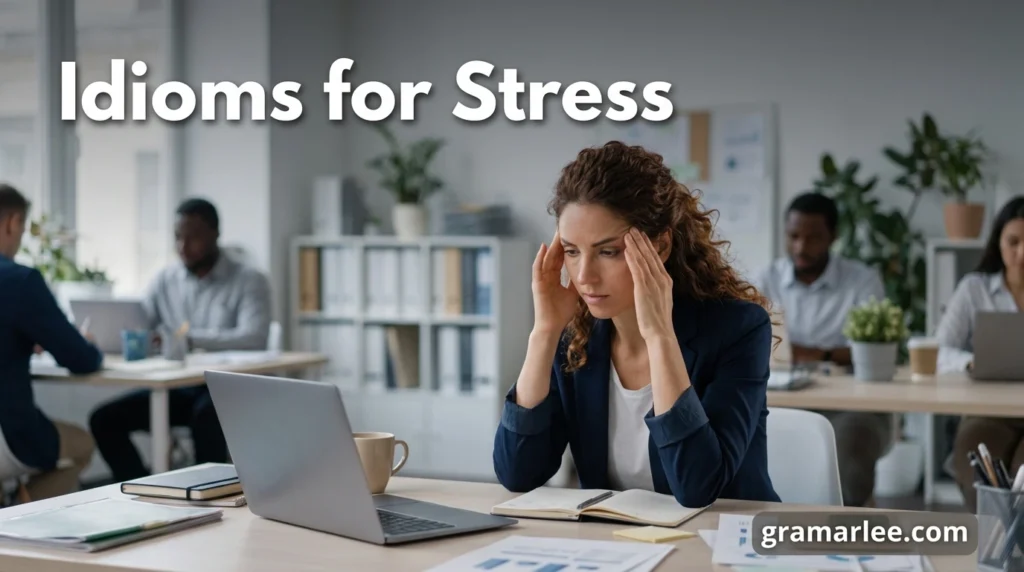
Stress is a common part of modern life, affecting students, professionals, business owners, and people from all walks of life. Learning idioms for stress helps English learners communicate emotions, challenges, and pressure more naturally and confidently. These expressions frequently appear in conversations, movies, books, workplaces, and academic settings.
By understanding and using stress-related idioms, you can improve your fluency, express yourself more accurately, and better understand native speakers. Whether you’re preparing for exams, handling workplace deadlines, or simply improving your English skills, mastering these idioms can make your communication more engaging and authentic.
What Are Idioms for Stress?
Idioms for stress are expressions that describe feelings of pressure, anxiety, nervousness, frustration, or mental overload. Their meanings are often different from the literal meanings of the words.
Why Learn Stress Idioms?
Benefits include:
- Sounding more natural in English conversations
- Understanding movies, TV shows, and podcasts
- Expressing emotions clearly
- Improving workplace communication
- Enhancing writing and speaking skills
Common Situations Where Stress Idioms Are Used
- Exam preparation
- Job interviews
- Work deadlines
- Family responsibilities
- Financial concerns
- Public speaking
- Sports competitions
Popular Idioms for Stress and Pressure
Under Pressure
Meaning: Experiencing stress due to expectations or responsibilities.
Example: “I’ve been under pressure all week because of the project deadline.”
Alternative Expressions:
- Feeling stressed
- Facing pressure
- Carrying a heavy workload
Typical Use Cases:
- Workplace discussions
- Academic settings
- Performance evaluations
Feeling the Heat
Meaning: Experiencing intense pressure or scrutiny.
Example: “The manager is feeling the heat after the company’s poor results.”
Fun Fact: This idiom compares pressure to physical heat, which often increases discomfort.
Idioms for Being Extremely Busy
Run Around Like a Headless Chicken
Meaning: Acting in a rushed, disorganized way.
Example: “I was running around like a headless chicken before the conference.”
Alternative Expressions:
- In a frenzy
- Rushing everywhere
- Extremely busy
Have Too Much on Your Plate
Meaning: Having more responsibilities than you can comfortably manage.
Example: “I can’t take another assignment. I already have too much on my plate.”
Typical Scenarios:
- Work overload
- Family commitments
- Academic responsibilities
Idioms for Anxiety and Nervousness
On Edge
Meaning: Feeling nervous, tense, or anxious.
Example: “Everyone was on edge before the final exam.”
Alternative Expressions:
- Nervous
- Uneasy
- Tense
Have Butterflies in Your Stomach
Meaning: Feeling nervous before an important event.
Example: “I always get butterflies in my stomach before public speaking.”
Fun Fact: The sensation of nervousness often creates a fluttering feeling in the stomach, inspiring this expression.
Idioms for Mental Exhaustion
Burn the Candle at Both Ends
Meaning: Working excessively without enough rest.
Example: “She’s been burning the candle at both ends to meet her deadlines.”
Origin: Candles burn faster when lit from both ends, symbolizing overwork.
Running on Empty
Meaning: Continuing despite having very little energy left.
Example: “After three nights without proper sleep, I’m running on empty.”
Idioms for Overwhelming Situations
At Your Wit’s End
Meaning: Completely out of ideas or patience.
Example: “I’m at my wit’s end trying to solve this issue.”
In Over Your Head
Meaning: Involved in a situation that is too difficult.
Example: “He realized he was in over his head after accepting the project.”
Alternative Expressions:
- Overwhelmed
- Outmatched
- Out of depth
Idioms for Emotional Stress
Carry the Weight of the World on Your Shoulders
Meaning: Feeling responsible for many problems.
Example: “You don’t have to carry the weight of the world on your shoulders.”
A Nervous Wreck
Meaning: Extremely anxious or stressed.
Example: “Before the interview, I was a nervous wreck.”
Workplace Idioms for Stress
Keep Your Head Above Water
Meaning: Manage to survive a difficult situation.
Example: “I’m just trying to keep my head above water with all these deadlines.”
Back to the Wall
Meaning: Being in a difficult situation with limited options.
Example: “The company had its back to the wall during the economic downturn.”
Academic Idioms for Stress
Hit the Books
Meaning: Study hard.
Example: “I need to hit the books before tomorrow’s exam.”
Sweat Over Something
Meaning: Worry excessively about something.
Example: “Don’t sweat over one bad test score.”
Idioms for Coping with Stress
Let Off Steam
Meaning: Release stress or frustration.
Example: “I go jogging after work to let off steam.”
Alternative Activities:
- Exercise
- Meditation
- Talking with friends
- Hobbies
Take It Easy
Meaning: Relax and avoid stress.
Example: “You’ve been working nonstop. Take it easy this weekend.”
Idioms for High-Stakes Situations
The Heat Is On
Meaning: Pressure is increasing.
Example: “The heat is on as the deadline approaches.”
Crunch Time
Meaning: A critical period requiring maximum effort.
Example: “It’s crunch time before the product launch.”
Idioms for Stress in Relationships
Walk on Eggshells
Meaning: Act very carefully to avoid upsetting someone.
Example: “Everyone was walking on eggshells after the argument.”
At Breaking Point
Meaning: Near emotional collapse.
Example: “She was at breaking point due to constant stress.”
Idioms for Recovering from Stress
Recharge Your Batteries
Meaning: Rest and regain energy.
Example: “I need a vacation to recharge my batteries.”
Clear Your Head
Meaning: Relax and think calmly.
Example: “A short walk helps me clear my head.”
Grouping Stress Idioms by Context
Workplace Stress
- Under pressure
- Feeling the heat
- Crunch time
- Keep your head above water
- Back to the wall
Student Stress
- Hit the books
- On edge
- Butterflies in your stomach
- Sweat over something
Personal Stress
- At your wit’s end
- Carry the weight of the world
- A nervous wreck
- At breaking point
Recovery and Relaxation
- Let off steam
- Take it easy
- Recharge your batteries
- Clear your head
Tips for Using Stress Idioms Effectively
Understand the Context
Not every idiom fits every situation. Use professional expressions in workplaces and casual expressions among friends.
Learn Through Examples
Practice using idioms in sentences rather than memorizing definitions.
Listen to Native Speakers
Watch interviews, podcasts, and movies to hear stress idioms used naturally.
Practice Speaking Regularly
Try incorporating one new idiom into your conversations each day.
Common Mistakes to Avoid
Using Idioms Literally
Incorrect: “I actually have butterflies inside my stomach.”
Correct: “I have butterflies in my stomach before presentations.”
Mixing Idioms
Avoid combining two unrelated idioms in one expression.
Overusing Idioms
Using too many idioms can make speech sound unnatural.
Ignoring Tone
Some idioms are informal and may not suit professional writing.
Practice Exercise: Fill in the Blanks
Easy Level
- I have too much on my ______.
- The deadline is tomorrow, and the heat is ______.
- Before the speech, I had butterflies in my ______.
Answers
- Plate
- On
- Stomach
Practice Exercise: Match the Idiom
Medium Level
Match the idiom with its meaning.
IdiomMeaningOn EdgeA. RelaxTake It EasyB. NervousLet Off SteamC. Release frustration
Answers
- On Edge → B
- Take It Easy → A
- Let Off Steam → C
Advanced Quiz on Stress Idioms
Multiple Choice Questions
1. Which idiom means working too much?
A. On edge
B. Burn the candle at both ends
C. Clear your head
Answer: B
2. Which idiom means feeling overwhelmed by responsibility?
A. Carry the weight of the world on your shoulders
B. Take it easy
C. Hit the books
Answer: A
3. Which idiom means releasing stress?
A. Crunch time
B. Let off steam
C. In over your head
Answer: B
Visual and Infographic Ideas
Infographic 1: Stress Idiom Categories
Sections:
- Anxiety
- Workplace Stress
- Student Stress
- Emotional Stress
- Recovery
Infographic 2: Stress Management Through Idioms
Flow Chart:
Stress → Pressure → Coping Strategy → Recovery
Infographic 3: Idiom Usage Scale
Informal → Neutral → Professional
This helps learners understand when to use each expression.
FAQs
What are the most common idioms for stress?
Some of the most common idioms include:
- Under pressure
- On edge
- Feeling the heat
- Crunch time
- Let off steam
Why should English learners study idioms for stress?
Stress-related idioms appear frequently in everyday conversations, movies, workplaces, and academic environments. Learning them improves comprehension and speaking skills.
Are stress idioms formal or informal?
Most are informal or semi-formal. Some, such as “under pressure” and “crunch time,” are commonly used in professional environments.
How can I remember stress idioms more easily?
- Use flashcards
- Practice with examples
- Watch English media
- Create personal sentences
- Use them in conversations
Can stress idioms be used in business communication?
Yes. Many workplace idioms such as “under pressure,” “crunch time,” and “keep your head above water” are commonly used in professional settings.
How many stress idioms should I learn at once?
Focus on five to ten idioms at a time and practice them repeatedly before learning more.
Conclusion
Learning idioms for stress is an excellent way to improve your English fluency and communicate emotions more naturally. These expressions help you describe pressure, anxiety, exhaustion, and recovery in ways that native speakers frequently use. By studying meanings, examples, contexts, and practice exercises, you can confidently apply these idioms in academic, professional, and everyday conversations. Continue practicing regularly, pay attention to how native speakers use these expressions, and gradually incorporate them into your own speaking and writing. Over time, these idioms will become a natural part of your English vocabulary, helping you express stressful situations with greater accuracy, confidence, and style.