
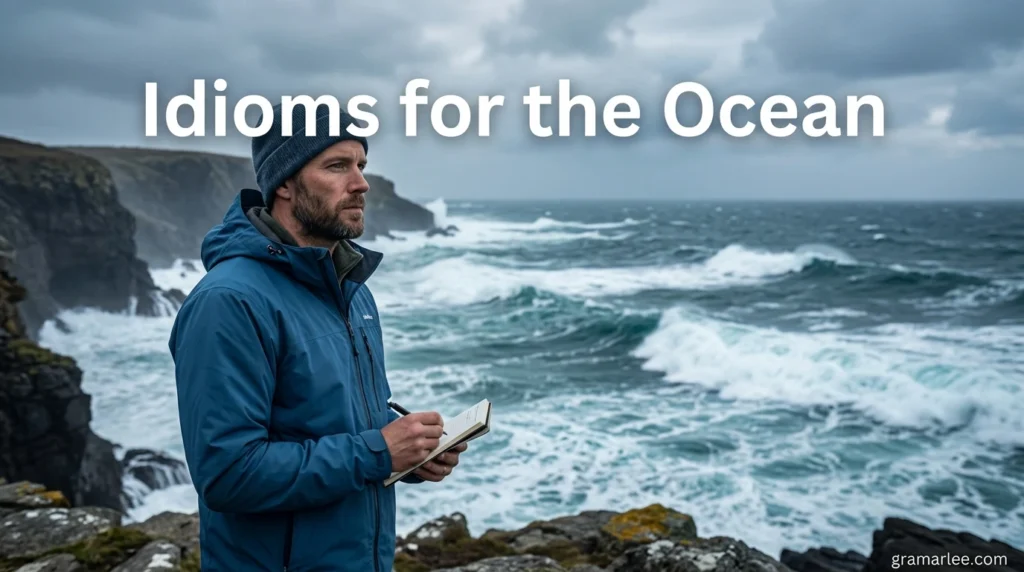
The ocean has always fascinated people with its beauty, power, and mystery. That is why idioms for the ocean are so common in English: they describe feelings, challenges, success, uncertainty, and movement in vivid, memorable ways. Learning these expressions helps you understand native speakers more naturally and speak with greater confidence in real life.
It also makes your English more colorful, expressive, and emotionally rich. Whether you are a student, a professional, or an English learner, these ocean idioms can improve your vocabulary and communication skills.
1. Why Idioms for the Ocean Matter
Ocean idioms are more than just interesting phrases. They appear in books, movies, business conversations, and everyday speech. When you understand them, you can follow conversations more easily and avoid confusion. They also help you express ideas in a smarter, more natural way.
For example, instead of saying someone is “very calm,” a speaker might say they are as cool as the sea on a quiet morning or simply use a sea-related expression like smooth sailing. These phrases create stronger pictures in the mind and make your English sound more fluent.
Ocean idioms are especially useful because the ocean represents many human experiences: peace, danger, depth, change, and survival. That is why these expressions work in both practical and emotional situations.
2. What “Idioms for the Ocean” Means
When people search for idioms for the ocean, they usually want English expressions connected to the sea, waves, tides, sailing, water, and marine life. These idioms may describe life events, moods, relationships, work, or success.
Some are directly about the ocean, while others borrow ocean imagery to explain abstract ideas. For example:
- Smooth sailing means something is easy or trouble-free.
- A drop in the ocean means something is very small compared to the whole.
- In deep water means being in serious trouble.
These expressions are useful because they are short, memorable, and packed with meaning.
3. Ocean Idioms That Suggest Calm and Ease
Some ocean idioms describe peace, comfort, and lack of difficulty. These are great for talking about easy situations or successful progress.
Smooth sailing
Meaning: A situation that is easy and free of problems. Example: “After the first week of training, the project was smooth sailing.” Alternative expressions: easy going, trouble-free, plain sailing Typical use: Work projects, school tasks, travel plans, relationships
Calm before the storm
Meaning: A quiet period before problems begin. Example: “The office was silent all morning, but it felt like the calm before the storm.” Alternative expressions: temporary peace, silent warning Typical use: News, business, family conflict, weather-related metaphors
Plain sailing
Meaning: Something that is easy to do. Example: “The exam looked hard, but the second half was plain sailing.” Alternative expressions: smooth progress, easy path Typical use: Learning, sports, travel, job tasks
These phrases are often used in positive or neutral situations, especially when speaking about progress or completion.
4. Ocean Idioms for Difficulty and Danger
The ocean can also represent fear, uncertainty, and risk. These idioms are common when people describe problems or pressure.
In deep water
Meaning: In serious trouble or difficulty. Example: “He forgot the report and was in deep water with his manager.” Alternative expressions: in trouble, in a bad position, in hot water Typical use: Work, school, legal problems, family issues
Out of your depth
Meaning: In a situation you do not understand or cannot handle well. Example: “She felt out of her depth during the advanced chemistry class.” Alternative expressions: overwhelmed, unprepared, over your head Typical use: Learning, new jobs, public speaking, technical tasks
Shipwrecked
Meaning: Completely defeated or ruined by a bad situation. Example: “Without proper planning, the whole campaign felt shipwrecked.” Alternative expressions: ruined, destroyed, failed badly Typical use: Business, relationships, group projects
A storm is brewing
Meaning: Trouble is starting to develop. Example: “There is tension in the team; a storm is brewing.” Alternative expressions: problems are building, conflict is coming Typical use: Offices, families, politics, social situations
These idioms are powerful because they create a strong emotional image of danger on the sea.
5. Idioms About Depth, Distance, and Scale
The ocean is vast, and many idioms use that image to describe size, intensity, or importance.
A drop in the ocean
Meaning: A very small amount compared with what is needed. Example: “The donation was generous, but it was still a drop in the ocean.” Alternative expressions: a tiny part, a small contribution Typical use: Money, charity, large problems, population issues
Deep as the ocean
Meaning: Very deep, intense, or profound. Example: “Her knowledge of literature is as deep as the ocean.” Alternative expressions: vast knowledge, profound understanding Typical use: Education, emotions, wisdom, relationships
Make waves
Meaning: Cause attention, change, or disturbance. Example: “The young designer made waves in the fashion world.” Alternative expressions: attract attention, create impact, stir things up Typical use: Careers, media, innovation, social change
Big fish in a small pond
Meaning: An important person in a small group or place. Example: “He was a big fish in a small pond at the local company.” Alternative expressions: local leader, top name in a small circle Typical use: Schools, companies, communities, clubs
These idioms help you talk about influence, size, and importance in a vivid way.
6. Idioms About Waves, Tides, and Currents
Water movement often symbolizes change, pressure, or natural flow in life.
Go with the flow
Meaning: Accept what is happening and do not resist too much. Example: “We did not have a fixed plan, so we just went with the flow.” Alternative expressions: stay flexible, adapt easily Typical use: Travel, social plans, teamwork, life decisions
Ride the wave
Meaning: Take advantage of a good opportunity or trend. Example: “The company rode the wave of online shopping growth.” Alternative expressions: benefit from the trend, capitalize on momentum Typical use: Business, marketing, career growth
Turn the tide
Meaning: Change a situation, especially from bad to good. Example: “A strong second half turned the tide for the team.” Alternative expressions: change the outcome, reverse the situation Typical use: Sports, politics, business, personal challenges
Go against the tide
Meaning: Act differently from the majority. Example: “She went against the tide and chose a less popular career.” Alternative expressions: be unconventional, resist the crowd Typical use: Personal choices, innovation, leadership
Wave and tide idioms are excellent for describing change, movement, and decision-making.
7. Idioms for Emotions and Personal Life
Many ocean idioms can also express feelings and relationships.
Stormy relationship
Meaning: A relationship full of conflict and emotional ups and downs. Example: “Their stormy relationship ended after many arguments.” Alternative expressions: unstable relationship, troubled bond Typical use: Dating, marriage, family conflicts
Lost at sea
Meaning: Feeling confused, unsure, or without direction. Example: “After graduation, I felt lost at sea for a few months.” Alternative expressions: directionless, uncertain, confused Typical use: Career changes, life transitions, emotional struggles
Keep your head above water
Meaning: Stay able to manage a difficult situation, especially financially or emotionally. Example: “With two jobs, she is just keeping her head above water.” Alternative expressions: survive, cope, manage to continue Typical use: Money, work stress, family responsibility
A sea of troubles
Meaning: A large number of problems. Example: “The company was facing a sea of troubles after the product recall.” Alternative expressions: many difficulties, huge mess Typical use: Business, health, relationships, life crises
These idioms are especially useful because they capture emotions in a simple, human way.
8. Ocean Idioms for Work, Study, and Business
Professionals and students often need ocean idioms in formal or semi-formal contexts. These expressions can make presentations, reports, and conversations more engaging.
Navigate difficult waters
Meaning: Handle a complicated or risky situation carefully. Example: “The manager helped the team navigate difficult waters during the merger.” Alternative expressions: manage complexity, deal with challenges Typical use: Business, law, politics, conflict management
Keep a steady course
Meaning: Stay consistent and focused. Example: “The company kept a steady course despite market changes.” Alternative expressions: stay on track, remain consistent Typical use: Leadership, planning, long-term goals
Change course
Meaning: Alter your plan or direction. Example: “After poor results, the marketing team changed course.” Alternative expressions: revise strategy, adjust direction Typical use: Strategy, education, career planning
Weather the storm
Meaning: Survive a difficult period. Example: “The small business weathered the storm and recovered.” Alternative expressions: endure hardship, survive tough times Typical use: Finance, business, family life, health recovery
These are excellent for professionals because they sound polished without being too informal.
9. Grouping Ocean Idioms by Context
A smart way to learn idioms for the ocean is by grouping them by context. This makes them easier to remember and use correctly.
easy situations
- Smooth sailing
- Plain sailing
- Go with the flow
problems and danger
- In deep water
- Out of your depth
- Weather the storm
change and action
- Make waves
- Turn the tide
- Change course
size and intensity
- A drop in the ocean
- Deep as the ocean
- A sea of troubles
This method helps your brain connect meaning with situation. Instead of memorizing random phrases, you learn them as useful tools.
10. Alternative Expressions and Synonyms
Learning similar expressions improves flexibility. It also helps you avoid repeating the same phrase too often.
Here are some helpful alternatives:
- Smooth sailing → easy, trouble-free, plain sailing
- In deep water → in trouble, in a bad spot, in hot water
- Go with the flow → adapt, stay flexible, follow the situation
- Make waves → attract attention, cause a stir, stand out
- Turn the tide → reverse the situation, change the outcome, shift momentum
Using alternatives is especially useful in essays, speaking exams, and professional writing.
11. Fun Facts and Origins of Ocean Idioms
Many ocean idioms come from sailing, fishing, and maritime life. Long before airplanes and modern communication, ships were essential for travel and trade. That is why so many English expressions use sea imagery.
Fun origin notes
- Smooth sailing comes from the idea of a ship moving easily over calm water.
- Weather the storm reflects the real danger of surviving bad weather at sea.
- Turn the tide connects to the natural movement of water and changing conditions.
- Make waves likely comes from the literal effect of movement on water, later used metaphorically for disruption or attention.
These origins make the idioms easier to remember. When you picture the ocean, the meaning becomes clearer.
12. Common Mistakes to Avoid
English learners often make small mistakes with idioms. Avoid these problems to sound more natural.
1. Using idioms too literally
Do not say “He is in deep water” when you mean someone is swimming. The idiom usually means trouble.
2. Mixing idioms
Avoid combining expressions like “smooth stormy sailing.” That sounds unnatural.
3. Using them in the wrong tone
Some idioms are informal, while others work well in business. Choose carefully.
4. Translating word for word
Idioms do not always match expressions in your first language. Learn the meaning, not just the words.
5. Overusing them
A few idioms make your speech interesting. Too many can sound forced.
These small habits can make a big difference in fluency.
13. Tips for Using Ocean Idioms Naturally
To use ocean idioms well, follow a few simple strategies.
Learn in chunks
Instead of memorizing one word at a time, learn the full phrase and one example sentence.
Match the situation
Use calm idioms for positive situations and stormy idioms for problems.
Practice speaking
Say the idiom aloud in short conversations. Repetition builds confidence.
Read and listen
Notice how writers, speakers, and presenters use these expressions in real life.
Keep a personal list
Write down your favorite sea idioms with meanings and example sentences.
When you use idioms naturally, your English becomes more fluent, expressive, and memorable.
14. Interactive Practice: Quiz and Fill-in-the-Blanks
Here is a short activity to test your understanding. Try it before checking the answers.
Easy level
- The project was __________ after the new plan was approved.
- She was __________ when the manager asked a technical question.
- The company had to __________ after the market changed.
Medium level
- His small donation was only __________.
- The team managed to __________ during the crisis.
- The new policy helped __________ in the competition.
Advanced level
- He went __________ and chose a path no one expected.
- The business was facing __________ after the scandal.
- She made __________ with her first research paper.
- The calm office felt like __________ before the announcement.
Answers
- smooth sailing
- out of her depth
- change course
- a drop in the ocean
- weather the storm
- turn the tide
- against the tide
- a sea of troubles
- waves
- the calm before the storm
Mini quiz
What does go with the flow mean? A. Fight every change B. To stay flexible and adapt C. To go swimming Answer: B
FAQs
1. What are idioms for the ocean?
They are English expressions inspired by the sea, waves, tides, sailing, and water. They often describe feelings, change, success, trouble, or uncertainty.
2. Why should English learners study ocean idioms?
They help you understand native speakers, improve fluency, and sound more natural in conversations, writing, and presentations.
3. Are ocean idioms used in business English?
Yes. Expressions like weather the storm, change course, and keep a steady course are common in professional settings.
4. Which ocean idiom means “in trouble”?
In deep water is one of the most common idioms for being in serious trouble.
5. Which idiom means “small amount compared to a large whole”?
A drop in the ocean means something very small compared with what is needed.
6. What idiom means “stay flexible”?
Go with the flow means to accept change and adapt rather than resist.
7. Are ocean idioms formal or informal?
Some are informal, like go with the flow, while others are suitable for formal writing, like weather the storm.
8. How can I remember these idioms faster?
Group them by meaning, create example sentences, and review them in real-life situations such as work, study, or storytelling.
9. Can I use ocean idioms in exams?
Yes, but use them carefully. They work well in speaking and writing tests when they fit the topic naturally.
10. What is the best way to practice idioms for the ocean?
Read, listen, and write your own examples. Then use them in short conversations until they feel natural.
Conclusion
Learning idioms for the ocean gives you more than vocabulary. It gives you confidence, creativity, and a deeper understanding of English culture. These expressions help you talk about calm moments, difficult situations, change, emotion, and success in a vivid way.
The best way to master them is simple: learn a few at a time, use them in sentences, and practice regularly. Over time, these ocean idioms, sea idioms, and English idioms will become part of your active vocabulary. That means you will not just recognize them—you will actually use them.
The sea is vast, and so is English. Keep practicing, keep exploring, and let these idioms carry your language skills forward.